Omnichannel Fulfillment: Benefits, Models & Strategy
Today’s shoppers might browse on their phone, buy through an app, pick up in store, and return by mail, all without thinking twice about switching between channels. Behind the scenes, though, making that happen is anything but seamless.
Omnichannel fulfillment brings those moving parts together by connecting inventory, orders, and fulfillment options across channels.
When done well, it can make operations more efficient while creating a smoother experience for customers.
The impact can be significant. Retailers with more mature, unified commerce operations report 27% lower fulfillment costs and 18% fewer abandoned carts.
So, what does it take to make omnichannel fulfillment work in practice?
In this guide, we will:
- Explain what omnichannel fulfillment is, how it works, and the models retailers use.
- Weigh its biggest benefits against the real challenges of managing it across channels.
- Show you how to build an omnichannel fulfillment strategy and the tech and automation that keep it running.
Omnichannel Fulfillment Explained
Omnichannel fulfillment is a connected approach to managing and delivering orders across every sales channel, from online stores and physical locations to mobile apps and third-party marketplaces.
Instead of managing inventory and orders separately for each channel, connected systems keep inventory and fulfillment operations coordinated.
Omnichannel vs. Multichannel Fulfillment: Key Differences
The way your fulfillment channels work together can make a big difference in how quickly and efficiently orders reach customers.
Here’s how omnichannel and multichannel fulfillment compare:
| Comparison | Multichannel Fulfillment | Omnichannel Fulfillment |
|---|---|---|
| Channel Integration | Sales and fulfillment channels often operate independently. | Sales and fulfillment channels are connected and coordinated. |
| Inventory Visibility | Inventory may be tracked separately for each channel. | Inventory is visible and synchronized across channels and locations. |
| Order Management | Orders are typically processed within separate channel-specific systems. | Orders are managed through integrated systems that coordinate fulfillment. |
| Order Routing | Orders generally follow predefined fulfillment paths for each channel. | Orders can be routed based on inventory availability, location, delivery speed, and cost. |
| Fulfillment Flexibility | Fulfillment options are often limited to those available within each channel. | Orders can be fulfilled through multiple locations and delivery or pickup options. |
| Returns Management | Returns may follow separate processes depending on the sales channel. | Returns can be coordinated across channels and fulfillment locations. |
How Omnichannel Order Fulfillment Works
Omnichannel order fulfillment brings orders, inventory, and fulfillment locations into one connected system.
From the moment an order is placed to the moment it reaches the customer, each step uses shared data to determine the most efficient path forward.
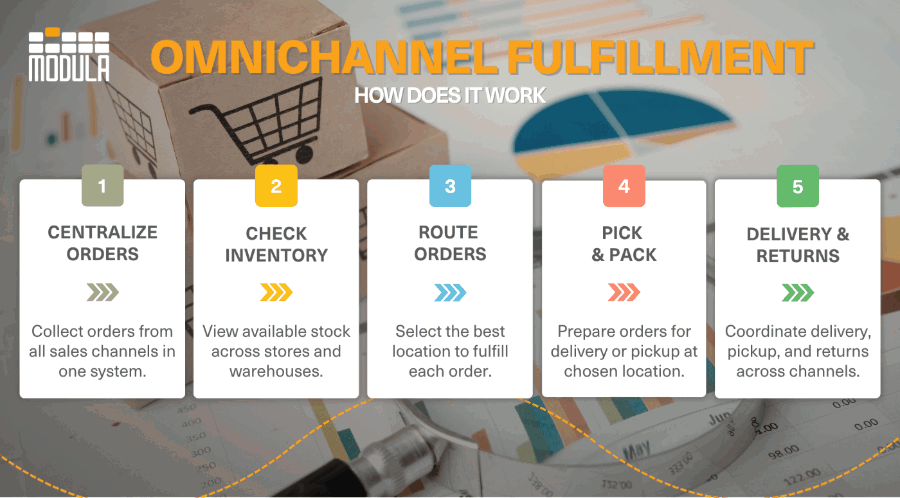
The Order Enters a Centralized System
Orders from your website, mobile app, marketplaces, social channels, and physical stores flow into a centralized order management system (OMS).
This gives your team a single place to view and manage orders, regardless of where the purchase happened.
Inventory Is Checked Across Locations
The system pulls a real-time view of available stock across warehouses, retail stores, and third-party logistics (3PL) centers.
With visibility across the entire network, businesses can source each order from wherever the right inventory is available, making omnichannel order fulfillment more flexible when demand or stock levels change.
The Best Fulfillment Location Is Selected
Once inventory is confirmed, smart routing determines where the order should be fulfilled based on availability, distance, delivery speed, and cost.
For instance, an order could ship from a nearby store instead of a warehouse if it gets the product to the customer faster.
The Order Is Picked and Packed
The selected location then prepares the order for delivery or pickup.
Since stores can also serve as local fulfillment hubs, businesses can use inventory that’s already closer to the customer instead of depending entirely on distribution centers.
Delivery and Returns Stay Connected
Finally, customers receive their orders through their preferred option, whether that’s home delivery, curbside pickup, or in-store pickup.
If an item is returned, connected systems update the order and inventory records, while the product is assessed before being made available for resale.
Keeping that information in sync helps omnichannel order fulfillment continue working smoothly even after the original purchase is complete.
7 Common Omnichannel Fulfillment Models and Approaches
There’s no single way to fulfill every order efficiently.
Depending on where inventory is stored, where the customer is located, and how they want to receive their purchase, businesses can use different fulfillment models to balance speed, convenience, and cost.
Order fulfillment can take different routes, including:
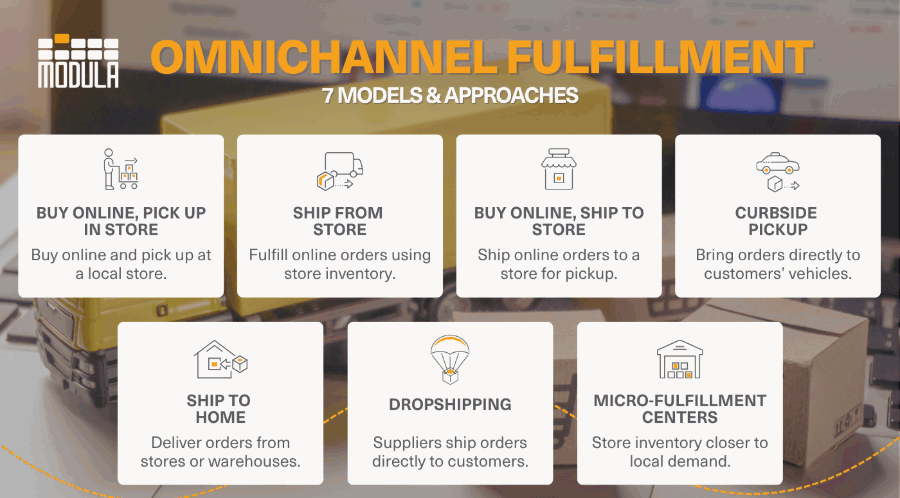
Buy Online, Pick Up in Store (BOPIS)
Customers place an order online and collect it from a nearby store.
It gives shoppers the convenience of buying online without waiting for home delivery, while helping retailers make use of inventory already available in stores.
Ship From Store
Instead of relying only on warehouses, retailers use physical stores to fulfill online orders.
Shipping from a location closer to the customer can shorten delivery distances and help move store inventory more efficiently.
Buy Online, Ship to Store (BOSS)
With BOSS, an online order is sent from a warehouse or distribution center to the customer’s preferred store for pickup.
It’s particularly useful when the item isn’t currently stocked at that location.
Curbside Pickup
Curbside pickup takes BOPIS a step further by bringing the order directly to the customer’s vehicle.
Customers get the speed of local pickup without having to enter the store.
Ship To Home
Orders are delivered directly to the customer from a warehouse, distribution center, or retail store.
In an omnichannel setup, the fulfillment location can be selected based on factors such as inventory availability, distance, and delivery cost.
Dropshipping
Rather than stocking and shipping every product themselves, retailers can have suppliers send certain orders directly to customers.
This can expand the available product range without requiring the retailer to hold additional inventory.
Micro-Fulfillment Centers
Micro-fulfillment centers place frequently ordered inventory closer to pockets of customer demand.
For retailers, that can reduce the distance and time involved in local deliveries while taking some pressure off larger distribution centers.
Top Benefits of Omnichannel Fulfillment
Giving customers more ways to buy is only part of the value of omnichannel fulfillment.
When inventory, orders, and fulfillment locations work as one network, retailers can maximize their resources while giving customers more flexibility in how they receive their purchases.
Get More From Your Inventory
Inventory doesn’t have to sit within a single channel or location.
With a connected fulfillment network, retailers can tap stock across stores and warehouses to meet demand and avoid losing sales when one location runs out.
That matters when inventory distortion remains at $1.7 trillion, according to a recent study.
Out-of-stocks account for nearly two-thirds of that loss, even though the needed inventory may already exist elsewhere in the retail network.
Omnichannel fulfillment can help make that stock visible and available where it’s needed.
Greater Operational Efficiency
A connected fulfillment network gives retailers more options for handling each order.
Orders can be routed based on inventory availability, customer location, shipping costs, and other business rules, helping minimize unnecessary transfers and make better use of warehouses, stores, and fulfillment teams.
Keep Customers Happy
Customers get more control over how and where they receive their purchases, whether that means home delivery, BOPIS, curbside pickup, or another option.
Better inventory visibility can also mean fewer canceled orders and stockouts, while smarter routing can help orders reach customers sooner.
What Makes Omnichannel Retail Fulfillment Challenging
Omnichannel retail fulfillment gives customers more ways to receive their orders, but managing all those options behind the scenes isn’t always simple.
Balance Delivery Speed With Fulfillment Costs
Customers want their orders fast. Meeting that expectation often means placing inventory closer to customers.
However, adding fulfillment locations also increases costs, making it important to balance faster delivery with an efficient network.
Keep Inventory Visible Across Locations
When inventory is spread across warehouses, stores, and in-transit shipments, getting an accurate view of what’s available becomes harder.
Without that visibility, retailers risk overselling products, missing opportunities to fulfill orders from another location, or carrying excess stock where demand is low.
Manage More Fulfillment Paths
BOPIS, curbside pickup, and ship-from-store all work a little differently behind the scenes.
Each has its own picking and routing needs, which can become difficult to manage when systems aren’t connected.
Keep Last-Mile Costs Under Control
Customers have come to expect fast, affordable shipping, but meeting that expectation can get expensive.
Longer delivery distances and inefficient routing only add to the cost, putting more pressure on already tight margins.
Make Returns Easier To Manage
Options like buy online, return in store (BORIS) make returns easier for customers but more complex for retailers.
NRF projected that U.S. merchandise returns would reach $849.9 billion in 2025, showing just how quickly that complexity can add up.
With online return rates reaching 19.3%, retailers need connected reverse logistics to inspect, process, and return merchandise to available inventory efficiently, while keeping processing and shipping costs under control.

How To Build an Omnichannel Fulfillment Strategy
There are a lot of moving parts behind omnichannel fulfillment.
Building an omnichannel fulfillment strategy means getting those pieces to work together instead of managing them separately.
Here’s where to start:
Start With Your Current Fulfillment Network
Before building an omnichannel fulfillment strategy, map out how orders currently move from purchase to delivery.
Look at where inventory is stored, which locations can fulfill orders, how long fulfillment takes, and where costs or delays tend to pile up.
These gaps will help you decide where omnichannel fulfillment can make the biggest difference.
Keep Inventory Visible Across Locations
Once you know how your network works, you need a reliable view of what’s in stock and where.
Keeping inventory updated across stores, warehouses, and other fulfillment locations helps you avoid overselling and put available stock to use wherever it’s needed.
Set Smarter Order-Routing Rules
Having visibility is only useful if you can act on it.
Establish rules that determine the best location to fulfill each order based on factors such as stock availability, distance, delivery time, shipping cost, and location capacity.
Keep in mind that the closest location isn’t always the best choice.
Connect the Systems Behind Fulfillment
A connected omnichannel fulfillment strategy depends on accurate information moving between your sales and fulfillment systems.
Connect eCommerce platforms, marketplaces, stores, and warehouse operations so inventory levels and order statuses stay in sync without relying on manual updates.
Choose the Right Fulfillment Options
With the foundation in place, decide which options actually make sense for your customers and network.
You don’t need to offer BOPIS, curbside pickup, ship-from-store, and BORIS all at once.
Start with the models that solve a clear customer or operational need, then expand as your network can support them.
Measure What’s Working
Your omnichannel fulfillment strategy should adapt as order volumes, customer expectations, and costs change.
Track warehouse KPIs such as fulfillment cost per order, order accuracy, delivery time, inventory turnover, and return processing time.
The goal is to find the mix that delivers the best service without adding unnecessary cost or complexity.
The Tech That Keeps Omnichannel Fulfillment Moving
Fulfilling an omnichannel order comes down to a few questions: What’s in stock, where is it available, and which location can get it to the customer efficiently?
Making those decisions quickly depends on having the right systems working together.
Here are four systems that help make it work:
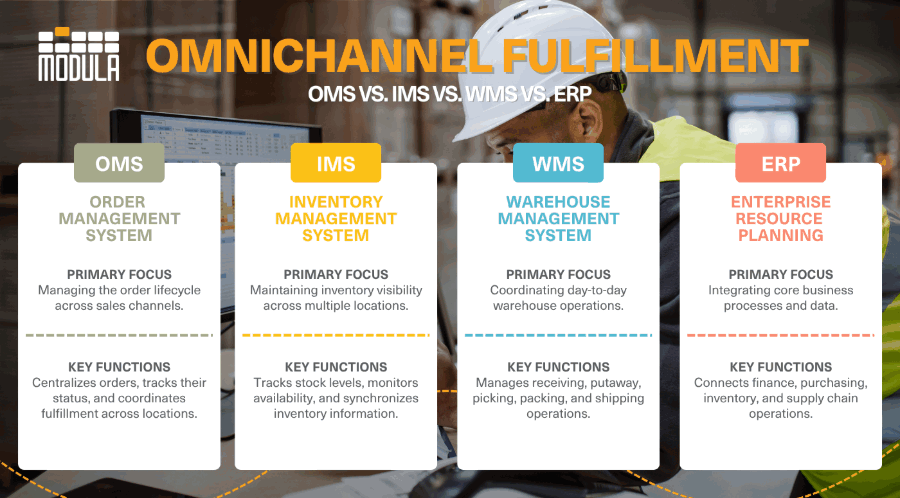
Order Management System (OMS)
An order management system (OMS) pulls orders from websites, apps, marketplaces, and stores into one place.
From there, it tracks each order and can determine the best fulfillment location based on inventory, distance, cost, and other business rules.
Inventory Management System (IMS)
An inventory management system (IMS) helps track and synchronize stock levels across warehouses, distribution centers, and stores.
That shared view helps retailers avoid overselling while finding inventory elsewhere in the network when one location runs low.
Warehouse Management System (WMS)
Once an order reaches the warehouse, a warehouse management system (WMS) helps teams find products and move them through picking, packing, and shipping.
It provides the inventory location and workflow data needed to get orders out the door efficiently.
For a closer look at how WMS connects with other warehouse systems, see our guide to WES vs. WMS vs. WCS and how they work together.
Enterprise Resource Planning (ERP)
Enterprise resource planning (ERP) brings fulfillment data together with areas such as finance, purchasing, and supply chain operations.
This gives teams a broader view of how inventory and fulfillment decisions affect the business as a whole.
Each system handles a different part of the process, but the real value comes from how well they share data.
When they work together, orders can move from checkout to fulfillment with fewer gaps and less manual coordination.
How Warehouse Automation Supports Omnichannel Fulfillment Across Channels
Connected systems can make smarter fulfillment decisions, but the warehouse still needs to execute them.
Automation can help bridge that gap, from inventory placement to picking and shipping.
Here are some of the technologies that make that possible:
AI and Analytics
AI-powered analytics can forecast demand, adjust safety stock, and help retailers decide where inventory should be placed.
With a better idea of what customers are likely to order and where, businesses can position stock closer to demand and plan fulfillment more effectively.
That’s where tools like Modula AI come in.
Modula AI uses machine learning to support demand forecasting and inventory optimization, helping businesses make more informed decisions about stock levels.
That gives retailers more room to prepare for shifts in demand instead of reacting after stock ends up in the wrong place.
Warehouse Robotics
Warehouse robotics and automated material handling systems can reduce manual travel and product movement during order fulfillment.
Technologies such as Conveyors, automated guided vehicles (AGVs), autonomous mobile robots (AMRs), and robotic picking systems help transport, handle, and pick products more efficiently, reducing manual handling and supporting faster order processing.
Modula extends that workflow by connecting its automated storage systems with autonomous mobile robots (AMRs) and robotic pickers through its dedicated robotic integrations.
Goods move between storage, picking, and packing with fewer manual handoffs, reducing bottlenecks and freeing employees for higher-value work.
Automated Storage and Retrieval Systems (ASRS)
Automated storage and retrieval systems (ASRS) help warehouses store inventory more efficiently and retrieve products with less manual handling.
Solutions such as Modula Vertical Lift Modules (VLMs) use vertical space to maximize storage capacity while delivering items directly to operators through a goods-to-person picking process.
When integrated with warehouse management software and other automation technologies, these systems can support faster, more accurate order fulfillment across multiple sales channels.
Integrated Shipping Software
Once an order is picked and packed, shipping software helps keep it moving.
These platforms connect fulfillment operations with carriers, making it easier to compare shipping options, generate labels, and keep tracking information up to date.
Omnichannel Fulfillment: Key Takeaways
- Omnichannel fulfillment connects your entire network: Orders, inventory, stores, warehouses, and sales channels work together, giving retailers more flexibility in how and where they fulfill customer orders.
- Inventory visibility and smart routing are central to omnichannel order fulfillment: With a real-time view of available stock, retailers can source orders from the right location based on availability, distance, delivery speed, and cost.
- Technology helps turn a connected strategy into an efficient operation: Systems such as OMS, IMS, WMS, and ERP keep fulfillment data connected, while warehouse automation can help optimize inventory placement, picking, and shipping.
Omnichannel Fulfillment: FAQs
What is omnichannel fulfillment?
Omnichannel fulfillment is a strategy that connects your sales channels, inventory, and fulfillment locations, making it easier for customers to buy, receive, and return orders wherever they choose to shop.
What types of businesses benefit most from omnichannel fulfillment?
Omnichannel fulfillment makes the most sense for retailers selling through several channels, such as ecommerce sites, marketplaces, apps, and physical stores.
For businesses managing growing online sales, omnichannel eCommerce fulfillment can help connect orders and inventory across these locations, making it easier to keep everything working together.
What is the difference between omnichannel fulfillment and omnichannel logistics?
The main difference is scope. Omnichannel fulfillment covers what happens after a customer places an order, including picking, packing, delivery, pickup, and returns.
Omnichannel logistics looks at the bigger picture, including how goods move through the supply chain before, during, and after fulfillment.
How does omnichannel fulfillment improve inventory management?
Instead of keeping inventory locked into separate channels or locations, omnichannel fulfillment gives retailers a clearer view of what’s available across the network.
With omnichannel eCommerce fulfillment, an online order can potentially be sourced from another store or warehouse when the usual location is out of stock.
This helps reduce lost sales while making better use of inventory across the network.