Pick and Place Automation: Robots, Applications & Benefits
Pick and place automation is becoming a common fixture on factory and warehouse floors.
Recent figures show that manufacturers installed 542,000 industrial robots worldwide, more than double the number installed a decade earlier.
That growth reflects a broader shift toward automating repetitive material handling tasks. Pick and place systems are one way companies are addressing these needs.
Using robotic arms, sensors, vision systems, and specialized end effectors, pick and place automation can handle repetitive lifting, sorting, positioning, and placement tasks while helping operations maintain throughput and accuracy without increasing headcount at the same rate.
In this guide, we will:
- Explain how pick and place automation works
- Share the main robot types and what to consider when choosing the right system for your operation
- See how Modula can support automated picking and material handling workflows
Pick and Place Automation Explained
Pick and place automation does exactly what its name suggests: it picks up an item from one location and moves it to another.
Using sensors, cameras, and robotic end effectors, these systems can automate repetitive tasks such as sorting products, packing orders, positioning components, or transferring materials between processes with minimal human involvement.
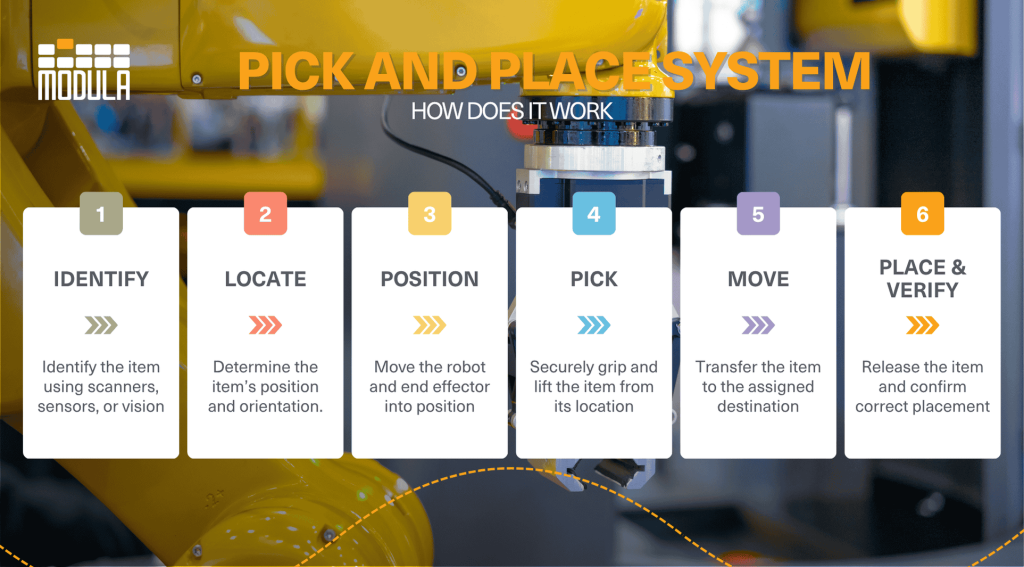
How Does a Pick and Place System Work?
Pick and place automation might sound complex, but the process is straightforward.
From identifying an item to moving it to the right location, each step is built to make product handling faster, more accurate, and less dependent on manual work.
Identify the Item
Pick and place automation begins when the system receives instructions about which item needs to be moved.
Barcode scanners, RFID readers, cameras, or other sensors identify the product and confirm its location.
More advanced systems can use computer vision to recognize products based on characteristics such as their size, shape, or position.
AI-powered vision can also help systems recognize variations in product position, orientation, or condition.
Locate the Item
Once the product is identified, the pick and place machine determines exactly where to retrieve it. The item might be stored in a bin, on a shelf, on a conveyor, or within an automated storage system.
Vision systems, sensors, and positioning data can help determine the item’s exact location and orientation so the robot can plan an accurate pick.
In warehouse applications, inventory management software can also help coordinate which item needs to be retrieved and from where.
Position the Robot
Next, the robotic arm or other automated handling equipment moves into position.
Depending on the product, the robot might use a mechanical gripper, suction cup, or another end-of-arm tool designed to handle the item safely.
Sensor and vision data can also help warehouse robots adjust to their surroundings and handle products with greater precision.
Pick the Item
The robot positions its end effector around or against the product and lifts it from its original location. Sensors can confirm that the item has been securely picked up before the robot moves on.
This added verification is particularly useful when a warehouse handles products with different sizes, weights or orientations.
Move the Item
With the item secured, the system moves it to its assigned destination.
Depending on the operation, that could be a conveyor, packing station, sorting area, storage location or another automated system.
Other warehouse technologies can then support movement beyond the robot’s work area.
For instance, autonomous mobile robots can transport materials between workstations or areas of a facility, complementing stationary pick and place systems.
Place and Verify the Item
Finally, the robot moves the product to its designated location and releases it. Sensors, scanners, or computer vision then confirm that the right item has been placed in the right spot.
Types of Pick and Place Robots
Pick and place robots come in different configurations. They vary based on factors such as load capacity, speed, reach, and range of motion.
The right robot for pick and place automation ultimately depends on the products being handled and the demands of the application.
Robotic Arms (Articulated Robots)
Robotic arms, also known as articulated robots, are among the most common pick and place robots because they offer a wide range of motion and can handle different product orientations.
A five-axis robotic arm works well for relatively straightforward movements, while a six-axis model provides an additional degree of freedom for twisting, rotating and repositioning items.
This flexibility makes robotic arms particularly useful for applications such as item picking, palletizing, machine tending and assembly.
SCARA Robots
SCARA robots, or Selective Compliance Assembly Robot Arms, are designed for fast, precise movements across a horizontal work area.
Their combination of speed, repeatability, and compact design makes them well suited for applications where products need to be picked, transferred, or assembled quickly.
SCARA robots are commonly used for electronics assembly, packaging, sorting, and other high-speed pick and place tasks involving relatively lightweight products.
Cartesian Robots
Cartesian robots move along three linear axes: X, Y, and Z. Rather than rotating through multiple joints, they travel in straight lines along a fixed framework.
This simple movement makes them well suited for pick and place automation applications that require consistent positioning and repeatable accuracy.
They are commonly used for machine loading, material transfer, assembly, and other applications that follow predictable linear movements.
Delta Robots
Delta robots, sometimes called spider robots, typically use three lightweight arms connected to a common base.
Their design allows them to perform rapid movements over a relatively limited working area.
Speed is their main advantage, making delta robots a strong fit for high-throughput applications involving lightweight products.
Common uses include food sorting, product assembly, dispensing, and material handling.
Collaborative Robots
Collaborative robots, or cobots, are designed for applications where robots and employees operate within a shared workspace.
They can take over repetitive handling tasks while employees focus on work that requires greater judgment or flexibility.
This makes cobots a practical option for pick and place automation in operations where people and robotic equipment need to work in close proximity.
Types of Pick and Place Robots
| Robot Type | Key Strength | Best Suited For |
|---|---|---|
| Robotic Arms | Wide range of motion and flexibility | Assembly, machine tending, palletizing, complex picking |
| SCARA Robots | Speed and repeatability | Electronics, assembly, packaging, high-speed picking |
| Cartesian Robots | Precise linear movement | Machine loading, material transfer, predictable movements |
| Delta Robots | Very high speed | Lightweight products, food sorting, packaging |
| Collaborative Robots | Human-robot collaboration | Applications where robots and employees work in close proximity |
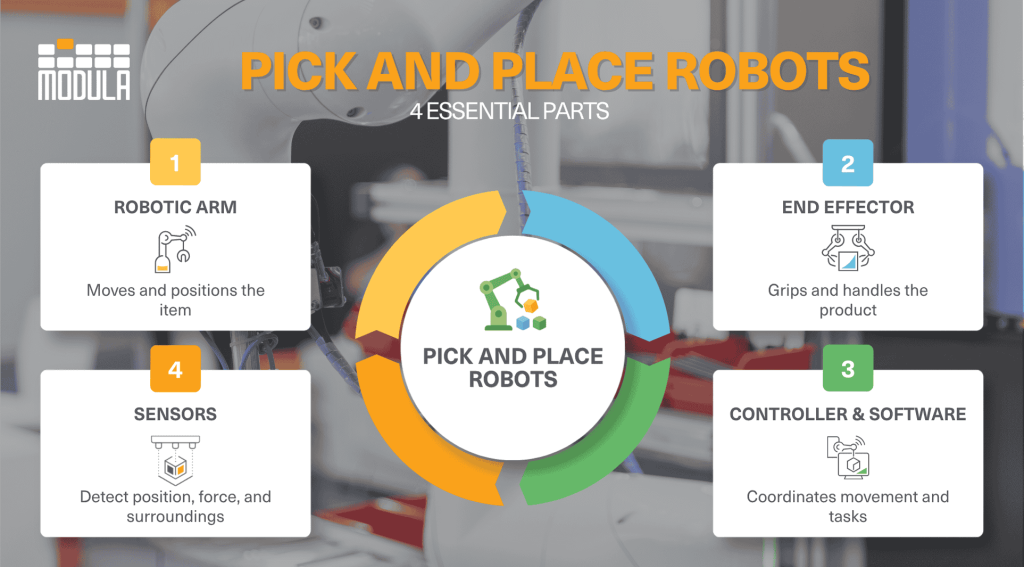
4 Essential Parts of a Pick and Place Robot
A pick and place robot relies on its robotic arm, gripping technology, sensors, and control system working together to identify, handle, and move products accurately.
Here’s a closer look at the components that make pick and place automation possible.
Robotic Arm
The robotic arm moves items from one location to another, with its size, reach, payload capacity, and range of motion determined by the products and application.
Cycle time, or how quickly the robot completes a task and is ready for the next one, is also important.
In high-throughput operations, shorter cycle times can significantly increase the number of picks completed.
The arm then integrates with sensors, controllers, and end effectors, allowing the pick and place robot to handle each item accurately and efficiently.
End Effectors
At the end of the robotic arm is the end effector, the component that physically interacts with the product. Think of it as the robot’s hand.
There is no single gripper that works for every application. The right choice depends on factors such as an item’s material, shape, weight, surface, and fragility.
Common options include:
- Vacuum grippers: These leverage suction to lift sealed boxes and products with smooth, nonporous surfaces. They are generally less suitable for porous materials or open containers that cannot maintain a reliable vacuum.
- Mechanical grippers: These utilize finger-like mechanisms to grasp products and can accommodate a variety of shapes and sizes. However, they need enough clearance around an item to establish a secure grip.
- Magnetic and adhesive grippers: Magnetic grippers can be used to lift compatible metal components, while adhesive gripping technologies can handle products that may be difficult to grasp mechanically.
Choosing the appropriate end effector helps the system maintain a secure grip without damaging the product during movement.
Sensors
A robot needs information about its surroundings before it can make an accurate pick. Sensors provide this feedback, helping the system locate products, monitor its grip, and detect nearby objects.
Pick and place automation relies on different types of sensors, including:
- Vision sensors: Using 2D or 3D cameras, vision systems help robots identify an item, determine its position and orientation, and decide where to grasp it. More advanced systems can combine computer vision with AI to recognize products and adapt to variations in their positioning.
- Force sensors: Often integrated into the end effector, force sensors measure the amount of pressure applied during a pick. This allows the robot to adjust its grip when handling delicate or irregular products and can help prevent damage.
- Proximity sensors: These detect nearby objects or obstacles, giving the robot information it can use to avoid unwanted contact within its operating area.
Controllers and Software
The controller coordinates the robotic system, processing data from sensors and software before sending commands to the motors, end effector, and other components.
Motion and task-planning software determines how the robot moves between pick and placement points while coordinating the sequence of actions required to complete each task.
Together, these hardware and software components form a complete pick and place robot that can identify, handle, transport, and place products with consistent accuracy.

Pick and Place Applications by Industry
What a pick and place system does can look different from one industry to the next, from sorting eCommerce orders to positioning components on a production line.
As more industries find ways to automate these repetitive handling tasks, demand for innovation continues to grow.
Fortune Business Insights projects the global pick and place robots market will grow from $2.5 billion in 2026 to $10.3 billion by 2034, with food and beverage leading the way in robot adoption, while eCommerce and logistics are quickly gaining ground.
Here’s how different industries leverage pick and place automation to handle these tasks:
Logistics and eCommerce
ECommerce warehouses and fulfillment centers use automated pick and place systems to retrieve products, sort orders, and transfer items to packing or shipping areas.
A pick and place system can be especially useful in high-volume operations, where reducing manual handling helps maintain throughput during demand spikes.
Automotive
In automotive manufacturing, robots can transfer components between workstations, load and unload machinery, and position parts for assembly.
These systems are particularly useful for repetitive tasks involving heavy components or precise positioning, helping maintain consistent movement throughout production.
Food and Beverage
Food and beverage operations use pick and place automation to sort, group, and package products moving along production lines.
For lightweight items produced at high volumes, an automated pick and place system can perform rapid, repetitive movements while maintaining consistent product positioning.
Pharmaceutical
Pharmaceutical operations can use robots to pick, sort, and package products such as medicine bottles, vials, blister packs, and cartons.
A pick and place machine can transfer these products between production and packaging stages with precise, repeatable movements.
This can help minimize unnecessary handling and maintain consistent product placement.
Electronics
Electronics manufacturing often requires small components to be handled quickly and positioned with a high degree of precision.
Pick and place robots can transfer, orient, and position components during assembly, testing, and packaging processes.
Robots such as SCARA and Delta systems can be particularly useful for repetitive, high-speed applications involving lightweight electronic components.
How To Choose the Right Pick and Place Solution
A pick and place system works best when it’s built around the demands of your production or warehouse operations.
That means accounting for the products you handle, the speed you need to maintain, the space you have available, and how the system will work with your existing warehouse equipment as demand changes.
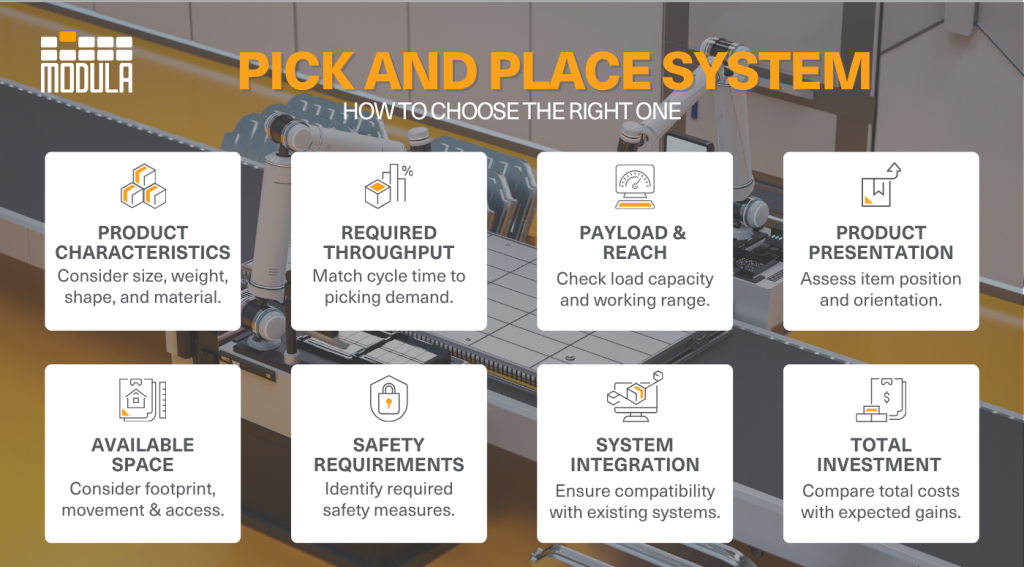
To maximize pick and place automation, here are the key factors to evaluate when comparing pick and place solutions:
Start With Your Products
Start by documenting the weight, dimensions, shape, material, and packaging of the products the system will handle. These factors determine the right robot and end effector.
For example, vacuum grippers work well with smooth, sealed cartons, while irregular or porous products might require mechanical grippers.
For a wide SKU mix, make sure the robot can switch between different product sizes and shapes without frequent manual adjustments.
Calculate Your Required Throughput
Determine how many picks the system must complete per minute or hour to keep up with downstream processes.
Then, compare that target with the robot’s cycle time under realistic operating conditions.
Remember to account for the complete cycle, including identifying, gripping, moving, placing, and releasing the product.
For operations with significant demand fluctuations, consider both average and peak throughput requirements when sizing the system.
Match Payload and Reach to the Application
Payload capacity is an important consideration for pick and place automation because it must account for both the product and the end effector attached to the robotic arm.
A robot rated for a particular weight may have less usable capacity once a gripper or other tooling is installed.
Reach is equally important. Map the furthest pick and placement points to confirm that the robot can access the entire work area without operating beyond its intended range.
Evaluate Product Presentation
How products arrive at the picking point can significantly affect system performance.
Items might come neatly arranged on a conveyor, stacked on pallets, stored in bins, or presented randomly.
Predictable product positioning generally requires simpler automation.
Randomly oriented or overlapping products might require 2D or 3D vision, advanced sensors, and software that can determine where and how to grasp each item.
Plan Around Your Available Space
Measure more than the robot’s footprint. Account for its full range of motion as well as conveyors, guarding, picking stations, maintenance access, and employee traffic.
Thoughtful warehouse design can help pick and place automation fit into the available space without creating bottlenecks or interfering with nearby equipment.
Evaluate Safety Requirements
Safety requirements should be considered when selecting and designing a pick and place system.
Factors such as robot type, payload, speed, end effector, and interaction with employees can influence the safeguards required for the application.
Depending on the system, these may include physical guarding, safety sensors, emergency stops, or other protective measures.
Check System Integration
Before investing in pick and place automation, determine what the robot needs to communicate with.
Depending on the application, this could include conveyors, automated storage systems, vision equipment, warehouse management systems (WMS), or enterprise resource planning (ERP) software.
Confirming compatibility early can help minimize integration challenges and help information move smoothly between systems.
Evaluate the Investment
When investing in pick and place automation, look beyond the purchase price and factor in installation, integration, software, training, maintenance, replacement parts, and downtime.
Weigh these costs against expected gains in throughput, accuracy, and labor efficiency to determine the system’s long-term value.
Benefits of Automated Pick and Place Systems
Automated pick and place systems can keep products moving without relying on employees for every repetitive pick, transfer, and placement.
That role is becoming increasingly important as businesses invest more heavily in automation.
According to the World Economic Forum’s Future of Jobs Report 2025, 58% of employers expect robotics and automation to transform their business by 2030.
These systems can deliver a wide range of operational advantages, including:
- Faster throughput: Robots can perform repetitive movements at a steady pace, helping facilities improve turnaround time in logistics and keep up with higher order or production volumes.
- Better accuracy: With sensors, vision systems, and programmed movements, robots can identify and position products precisely, helping lower picking and placement errors.
- Less manual handling: Tasks that involve repeated lifting, reaching, sorting, or transferring can be automated, reducing the amount of hands-on work required from employees.
- Reduced product damage: The right grippers, sensors, and controls help regulate how products are picked up and moved, which can be especially useful for fragile or delicate items.
- Scalability: As order or production volumes increase, automation can help facilities handle additional throughput without adding manual labor at the same rate.
How Modula Supports Automated Picking and Material Handling
Pick and place robots are one part of a broader automated material handling strategy.
Efficient operations also depend on how inventory is stored, presented, picked, and moved between processes.
Modula supports these workflows through automated storage, picking technologies, warehouse management software, and integration capabilities that help coordinate the flow of materials across warehouse and manufacturing operations.
Automated Storage and System Integration
Modula automated storage systems can bring required inventory directly to the access bay, reducing the need for operators to walk through the facility and search for products.
For more advanced automation environments, Modula Link allows third-party host systems to communicate directly with and control Modula VLMs.
The external system can determine when a tray is delivered to the bay and when it is returned, helping integrate automated storage into broader material handling workflows.
Picking Aids for Operator-Assisted Workflows
Not every picking process requires a fully robotic solution. For operator-assisted workflows, Modula offers picking technologies designed to guide employees through picking and order consolidation tasks.
Our pick and place solutions include:
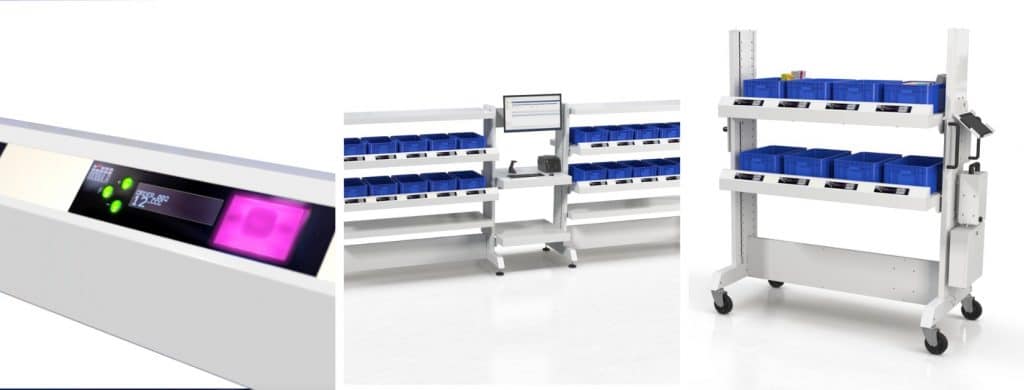
- Modula Put to Light: Running in batch or multi-order mode, the Put to Light System allows teams to fulfill several orders at once, lifting throughput without adding headcount.
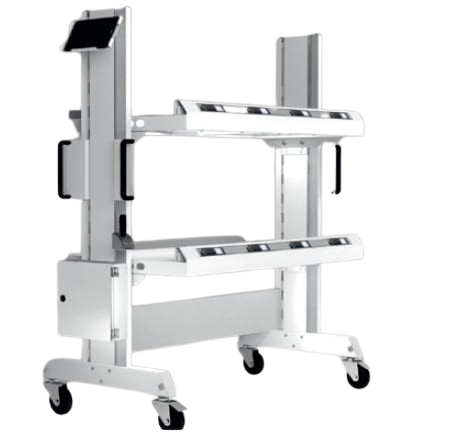
- Modula Picking Station: Built to handle both batch and multi-order fulfillment, the Picking Station offers a flexible, high-precision way to close out more orders in less time. Plus, its fully paperless setup removes the need for printed order lists, so picking never slows down.
- Modula Picking Cart: For teams that need mobility, the Picking Cart brings paperless batch and multi-order picking straight to the aisle. Its built-in put-to-light display and wireless link to your WMS map the most efficient route, so operators spend less time walking and more time picking.
- Modula Mobile Picking App: The Mobile Picking App keeps operators connected with live updates and full control of every warehouse task.
- Modula Pick to Color Picking: This offers a cost-effective alternative to traditional put to light systems, using standard picking carts, color-based instructions, and barcode confirmation to guide operators through fulfillment without requiring a full put-to-light setup.
Software and Integration
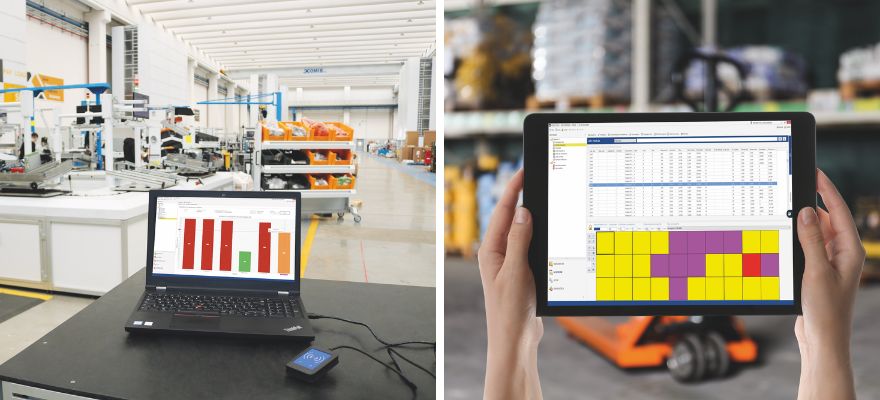
Modula WMS provides real-time inventory control and manages automated storage systems from a central application.
It can also exchange data with a company’s ERP to coordinate item information, orders, and warehouse activities.
For operations that already use an external WMS or ERP to manage warehouse logistics, Modula Driver and Modula Link provide additional ways to communicate with and control Modula automated storage systems.
Pick and Place Automation: Key Takeaways
- Pick and place automation brings together robots, end effectors, sensors, vision technology, and control software to identify, move, and place products accurately.
- Automated pick and place systems cut down on manual handling and boost throughput across industries, including logistics, eCommerce, manufacturing, food and beverage, pharmaceuticals, and electronics
- The right pick and place solution depends on factors such as product characteristics, throughput, payload and reach, product presentation, available space, safety requirements, integration needs, and overall investment.
Pick and Place Automation: FAQs
Can pick and place systems handle different products?
Yes, but the level of flexibility depends on the system.
Robots equipped with adaptable grippers, vision systems, and programmable software can handle products with different sizes, shapes, and orientations.
Operations with a broad SKU mix should evaluate how easily the system can switch between products without lengthy changeovers or manual adjustments.
What is the difference between pick and place automation and order picking automation?
Pick and place automation typically refers to robotic systems that physically grasp an item, move it, and place it in another location.
Order picking automation is a broader category that can include automated storage systems, goods-to-person solutions, picking aids, mobile robots, and software that help retrieve, identify, transport, or consolidate inventory.
The two can also work together as part of a larger automated material handling system.
How much maintenance do pick and place robots require?
Maintenance requirements depend on the robot and how heavily it is used.
Routine inspections typically focus on components, such as:
- Grippers
- Sensors
- Cables
- Joints
- Other moving parts
Following the manufacturer’s preventive maintenance schedule can help reduce unexpected downtime and extend equipment life.
How much does pick and place automation cost?
The cost of pick and place automation varies depending on the robot, end effector, vision technology, software, integration requirements, and complexity of the application.
Rather than looking at equipment cost alone, businesses should consider total cost of ownership and potential savings from higher throughput, less manual handling, and fewer errors.
Warehouses should have a backup process in place, such as RF scanners or manual pick lists, so orders can continue moving until the system is restored.