Reshoring Manufacturing: Benefits, Challenges & Automation
Reshoring is gaining momentum across U.S. manufacturing. Tariffs, supply chain disruptions, and federal incentives are giving companies more reasons to bring production back home.
However, bringing production back is only part of the challenge. Manufacturers also have to make the numbers work.
Labor is a big part of that equation. There are already more than 400,000 open manufacturing jobs, and Deloitte estimates the industry will need 3.8 million workers by 2033, with nearly half of those roles at risk of going unfilled.
Combined with higher U.S. wages, these workforce constraints make recreating labor-intensive operations at home difficult to justify.
This is where automation can make a difference.
Robotics, automated storage and retrieval, and other advanced automation technologies can help
manufacturers increase productivity with smaller teams, reduce reliance on manual processes, and build more resilient domestic operations.
In this article, we will:
- Explain what reshoring in manufacturing is and why it’s growing
- Cover the key reshoring benefits and challenges for manufacturers and supply chains
- Explore how automation can support domestic manufacturing and how Modula can help

Understanding Reshoring
Reshoring is the process of bringing manufacturing and production activities back to a company’s home country after they’ve been relocated overseas through offshoring or outsourcing.
As international supply chains become more complex and vulnerable to disruptions, organizations are reassessing the long-term costs, risks and operational challenges of manufacturing abroad.
As a result, many companies are reshoring manufacturing to improve supply chain resilience, strengthen quality oversight, and expand domestic production.
Reshoring vs. Offshoring vs. Nearshoring
While these strategies all relate to where companies manufacture or source products, they involve different approaches:
- Offshoring moves production or business activities from the home country to another country, often to reduce costs.
- Nearshoring moves production to a nearby country, allowing companies to remain closer to their primary market while retaining some of the advantages of international production.
- Reshoring brings previously offshored production back to the company’s home country.
The right approach depends on factors such as labor and production costs, supplier availability, transportation, lead times, operational risk, and proximity to customers.
| Strategy | What It Means | Key Consideration |
|---|---|---|
| Reshoring | Bringing previously offshored production back to the company’s home country | Greater control and proximity to the domestic market |
| Nearshoring | Moving production to a nearby country | Balances proximity with some advantages of international production |
| Offshoring | Moving production or business activities to another country | Often used to access lower production or labor costs |
Why U.S. Manufacturing Reshoring Is Growing
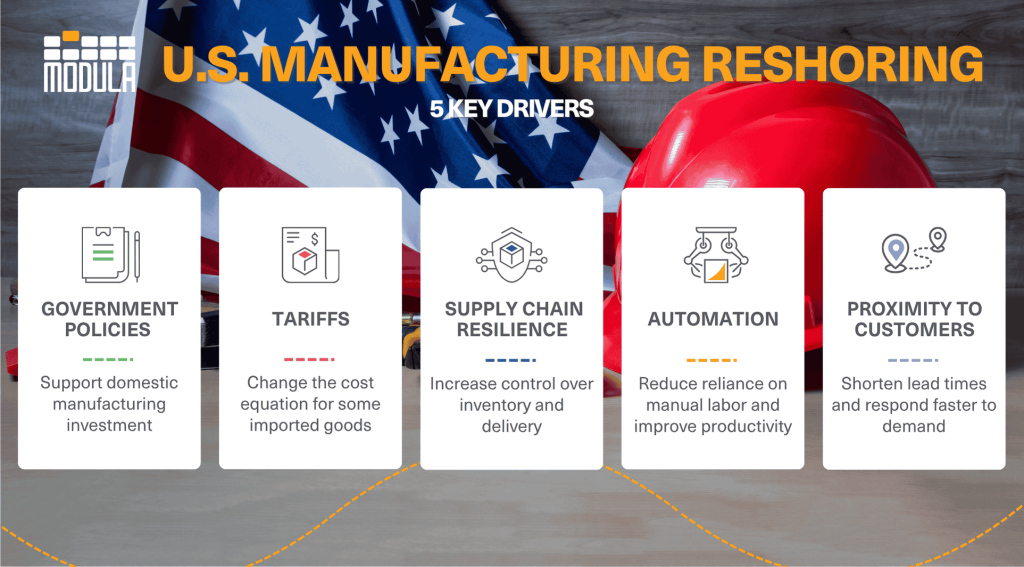
Reshoring isn’t driven by a single factor.
Instead, it’s the result of several economic, operational, and technological shifts that are making U.S. manufacturing more competitive.
Government Policies and Incentives Are Supporting Domestic Manufacturing
For many manufacturers, the financial case for building in the U.S. has become stronger.
An established 21% corporate tax rate, renewed allowances for immediate expensing of qualifying manufacturing facilities, and federal programs like the CHIPS Act have lowered the cost of investing domestically.
Combined with targeted incentives for industries such as semiconductors, clean energy and defense, these policies are encouraging more companies to build and expand production in the U.S.
Tariffs Changed the Cost Equation
Tariffs have also made reshoring more appealing by increasing the cost of imported goods.
Instead of comparing domestic production solely with low overseas labor costs, companies also need to account for tariffs and other costs associated with importing products and materials.
This can change the overall cost equation when manufacturers evaluate where to locate production.
Companies Are Prioritizing Supply Chain Resilience
The pandemic and global shipping disruptions exposed the vulnerabilities of long, complex supply chains.
As a result, many manufacturers are rethinking the tradeoff between cost and resilience.
Producing closer to home gives companies greater control over quality, inventory, and delivery timelines while helping reduce the impact of future disruptions.
Automation Is Making Reshoring More Practical
Automation has fundamentally changed the economics of manufacturing.
Modern factories rely on robotics, AI, and advanced production systems to handle repetitive tasks with greater speed and consistency.
Since labor now represents a smaller share of production costs, higher U.S. wages carry less weight in location decisions.
Manufacturers can instead prioritize faster delivery, stronger quality control, and more resilient supply chains without sacrificing competitiveness.
Proximity to Customers Can Reduce Lead Times
Bringing production closer to U.S. customers can help manufacturers shorten lead times and respond more quickly to changes in demand.
Shorter supply chains can also reduce the amount of inventory tied up in transit and limit exposure to international transportation delays.
For manufacturers operating in fast-changing markets, greater proximity to customers can provide more flexibility to adjust production and inventory as demand changes.
6 Reshoring Benefits for Manufacturers and Supply Chains
Beyond strengthening domestic manufacturing, reshoring offers a wide range of operational and strategic benefits that can improve supply chain performance and long-term business resilience.
Top reshoring benefits include:
Stronger Supply Chain Resilience
One of the biggest reshoring supply chain benefits is greater control over suppliers, inventory, and delivery timelines.
Shorter supply chains make it easier to manage disruptions and maintain continuity.
Whether it’s a transportation delay, supplier issues, or sudden spike in demand, manufacturers can react faster and adjust operations accordingly.
This emphasis on resilience is also influencing where companies invest.
In 2024, companies announced 244,000 U.S. manufacturing jobs through reshoring and foreign direct investment (FDI).
Better Product Quality
Manufacturing closer to home makes it easier to oversee production and maintain consistent quality standards.
Teams can work more closely with suppliers, monitor processes in real time, and address issues before they become costly problems.
For industries like aerospace and electronics, where precision and compliance are essential, that level of oversight can make a significant difference.
More Jobs and Stronger Local Economies
Domestic manufacturing doesn’t just bring production back; it also creates demand for skilled workers across manufacturing, engineering, logistics, and maintenance.
Those investments support local suppliers, strengthen regional manufacturing ecosystems, and contribute to broader economic growth.
Lower Total Supply Chain Costs
While domestic labor costs are often higher, labor is only one part of the equation.
When evaluating reshoring, manufacturers need to consider the total cost of ownership, including international logistics costs, tariffs and duties, inventory carrying costs, longer lead times, safety stock, quality issues, and potential supply chain disruptions.
A well-planned reshoring supply chain strategy can reduce some of these costs, help offset higher domestic production costs, and improve responsiveness and customer service.
Stronger Intellectual Property Protection
For companies that compete through innovation, keeping production closer to home offers an added advantage.
Better oversight of proprietary designs, manufacturing processes and sensitive data helps reduce the risk of intellectual property theft, counterfeiting, and unauthorized technology transfers.
A Smaller Environmental Footprint
Producing goods closer to end markets can also support sustainability goals.
Shorter transportation routes decrease shipping-related emissions, while domestic manufacturing may also reduce some of the environmental impacts associated with long global supply chains.
In fact, a recent study found net carbon savings across every reshoring scenario it modeled.
For companies looking to reduce their carbon footprint and strengthen ESG initiatives, domestic manufacturing can support both environmental and operational goals.

Common Reshoring Challenges
While reshoring offers clear advantages, it also comes with operational challenges that require careful planning.
Understanding these obstacles can help manufacturers build a more efficient strategy.
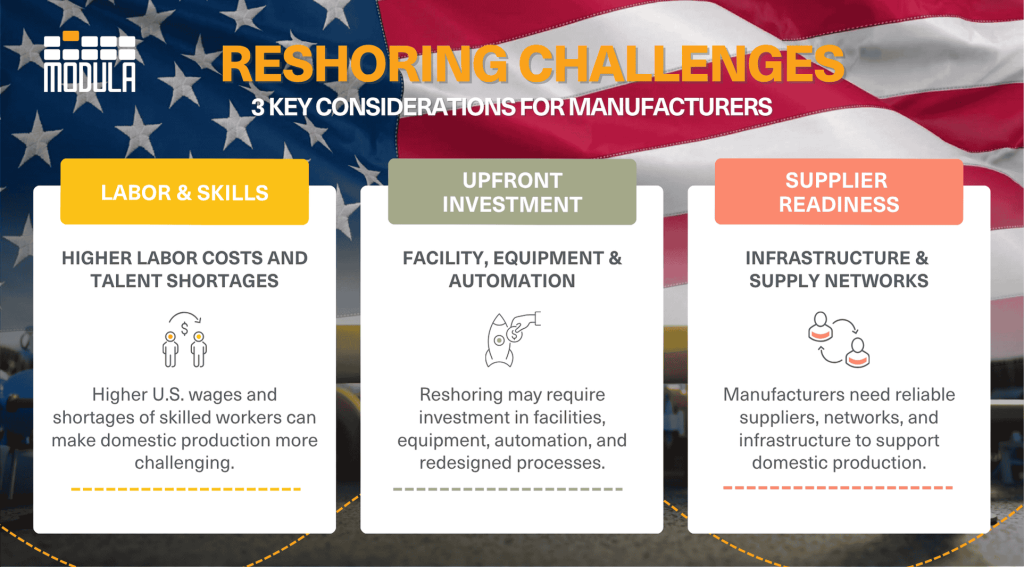
Higher Labor Costs and Talent Shortages
Labor remains one of the biggest challenges.
While higher U.S. wages can increase production costs for labor-intensive operations, many manufacturers also face a shortage of skilled workers in areas such as:
- Advanced manufacturing
- Automation
- Maintenance
For this reason, companies reshoring manufacturing often need to invest in workforce training, apprenticeships, and upskilling.
Upfront Investment Requirements
Reshoring can require significant upfront investment, particularly when companies need to build or expand facilities, purchase new equipment, implement automation, or redesign production processes.
Manufacturers need to evaluate these upfront costs against the expected long-term operational and strategic benefits of bringing production closer to home.
Infrastructure and Supplier Readiness
Bringing production closer to home often requires more than building a new facility.
An efficient reshoring supply chain strategy also depends on reliable suppliers, transportation networks, and supporting infrastructure.
In some industries, domestic supplier networks are still developing, making it necessary to qualify new vendors, invest in local partnerships, or redesign parts of the supply chain.
Companies that take a phased approach to shifting production domestically can better manage these challenges while minimizing operational disruption.
The Role of Automation in Reshoring Manufacturing
Automation can help manufacturers address some of the cost, labor, and operational challenges associated with reshoring.
Its role extends across production, from improving productivity and flexibility to supporting more consistent quality.
Lower Costs and Greater Flexibility
By increasing productivity and reducing reliance on repetitive manual processes, automation can help manufacturers offset some of the higher labor costs associated with domestic production.
It can also give manufacturers greater flexibility to scale production and respond to changing demand.
As a result, location decisions can place greater emphasis on factors beyond labor costs, including supply chain resilience, proximity to customers, and access to reliable suppliers.
Better Quality and Faster Production
Automation can help manufacturers maintain more consistent quality while increasing production speed.
AI-powered cameras, machine vision systems, and smart sensors detect defects in real time, helping maintain consistent quality while reducing waste and rework.
Connected manufacturing systems provide real-time production data that allows facilities to adjust output, optimize workflows, and respond quickly to changing demand.
Combined with shorter transportation routes, these capabilities help manufacturers deliver products faster while maintaining operational efficiency.
How Warehouse Automation Supports Reshoring Supply Chain Operations
As manufacturers localize production, warehouse automation becomes an important part of a reliable reshoring supply chain strategy.
Bringing production closer to home also means managing the materials that keep production running, from raw materials and components to tools, work-in-process inventory, and spare parts.
Efficient storage and material flow can help ensure these items are available when and where they are needed.
Here’s how it can help boost reshoring efforts:
Addressing Domestic Manufacturing Challenges
- Labor shortages: Automated picking, storage and retrieval systems reduce dependence on manual labor by handling repetitive tasks, allowing employees to focus on higher-value activities such as quality control and equipment management.
- Limited warehouse space: High-density storage solutions, such as Vertical Lift Modules (VLMs) and automated storage and retrieval systems (ASRS), maximize vertical space, helping manufacturers increase storage capacity without expanding their facilities.
- Higher operating costs: Automation improves throughput and labor productivity, enabling manufacturers to produce more with the same workforce while helping offset higher domestic wages.
Improving Speed and Operational Agility
- Production replenishment: Automated storage and material handling can help keep components and materials available at the point of use, reducing time spent searching for or waiting on the items needed for production.
- Real-time inventory visibility: Warehouse management systems (WMS), RFID technology and IoT sensors provide accurate, real-time inventory data, helping manufacturers reduce stock discrepancies and support just-in-time production.
- Scalable operations: Modular automation solutions can be expanded or reconfigured as production volumes change, allowing manufacturers to adapt to seasonal demand, new product lines or business growth without major facility redesigns.
How Modula Helps Manufacturers Build More Resilient Operations
Efficient manufacturing strategies depend on more than efficient production lines.
Modula helps manufacturers improve inventory flow, optimize storage space, and keep the inventory needed for production organized and accessible.
Automated Storage and Retrieval Systems (ASRS)
As our ASRS guide explains, automated storage and retrieval systems improve inventory accuracy and reduce manual handling by automatically storing and retrieving materials.
Instead of relying on operators to search for inventory, these solutions deliver the right item directly to the picking station, reducing travel time and improving order accuracy.
For manufacturers bringing production closer to home, ASRS also helps offset labor shortages, increase throughput, and make better use of available warehouse space.
Vertical Lift Modules (VLMs)
Rising warehouse costs are pushing manufacturers to get more value from their existing footprint.
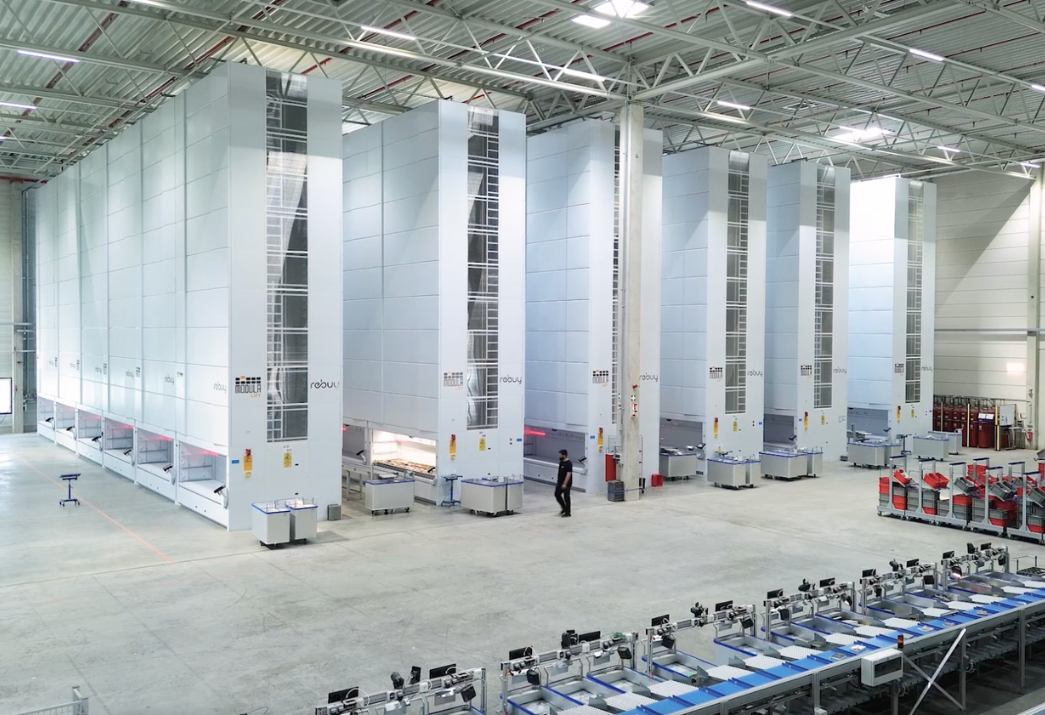
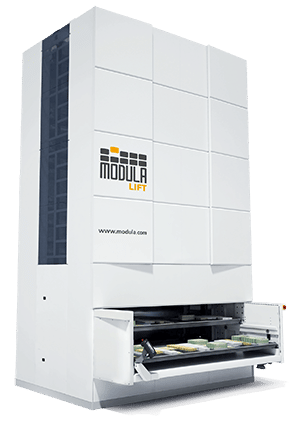
Modula’s vertical storage solutions use available ceiling height to store inventory vertically, increasing storage capacity within a compact footprint while keeping materials organized and accessible.
VLMs can be positioned close to production areas to support faster access to components, tools, and other materials needed on the production floor.
Warehouse Robots
Warehouse robots automate repetitive material handling tasks that often slow warehouse operations.
Robotic systems can transport inventory, assist with picking and support material movement between storage and production areas, allowing employees to focus on higher-value activities.
For manufacturers facing labor shortages or increasing order volumes, warehouse robotics improves productivity while creating a safer and more consistent work environment.
Autonomous Mobile Robots (AMRs)
Autonomous mobile robots (AMRs) move materials throughout a facility without fixed conveyors or manual transportation.
Leveraging sensors and intelligent navigation, AMRs automatically select efficient travel paths while safely operating alongside warehouse employees.
Since AMRs can be deployed without major facility modifications, they give manufacturers the flexibility to scale operations, adapt to changing production needs, and improve material flow as demand evolves.
See our AMRs guide for more on their capabilities.
Reshoring Explained: Key Takeaways
- Reshoring is gaining momentum: Tariffs, federal incentives, and supply chain risks are making domestic production more attractive
- Automation helps offset higher U.S. labor costs: Robotics and AI and advanced manufacturing technologies can help manufacturers increase productivity, reduce reliance on manual labor, and offset some of the higher costs associated with domestic production.
- Warehouse automation supports domestic manufacturing: Automated storage and robotics help manufacturers overcome labor and space constraints while improving throughput and scalability
Reshoring Explained: FAQs
Which industries are best suited for reshoring?
Reshoring tends to make the most sense for industries where quality, speed, intellectual property protection, and supply chain reliability are just as important as labor costs.
This can be especially relevant for manufacturers that need tighter control over production or faster access to customers.
What should manufacturers consider before reshoring?
Manufacturers should look at the bigger picture, not just production costs.
Workforce availability, suppliers, infrastructure, transportation, automation, and proximity to customers can all affect whether the move makes sense.
Considering these factors upfront can help companies build a more practical reshoring strategy.
Is reshoring right for every manufacturer?
Not exactly. What works for one manufacturer may not work for another.
Companies need to weigh the costs and complexity of moving production against potential benefits, such as greater control, shorter lead times, and a more resilient supply chain.
How does automation support reshoring?
Automation can help manufacturers address some of the labor, cost, space, and productivity challenges associated with domestic production.
Manufacturing automation can reduce repetitive manual work and improve production efficiency, while warehouse automation can help manufacturers store, retrieve, and move materials more efficiently.
Together, these technologies can make it easier to scale domestic operations while reducing reliance on manual processes.