Warehouse Robots: 15 Types, Benefits and Use Cases
Warehouse robots are becoming an important part of modern warehouse operations, helping companies move, store, pick, sort, and track inventory with greater speed and consistency.
According to a global industry tracking study by Statista, the adoption of warehouse automation technology is expected to increase significantly by 2030, showing how quickly facilities are moving toward more automated and software-connected operations.
As order volumes increase and labor availability remains a challenge, many facilities are using warehouse robotics to reduce manual travel, improve picking accuracy, and keep materials moving efficiently across the operation.
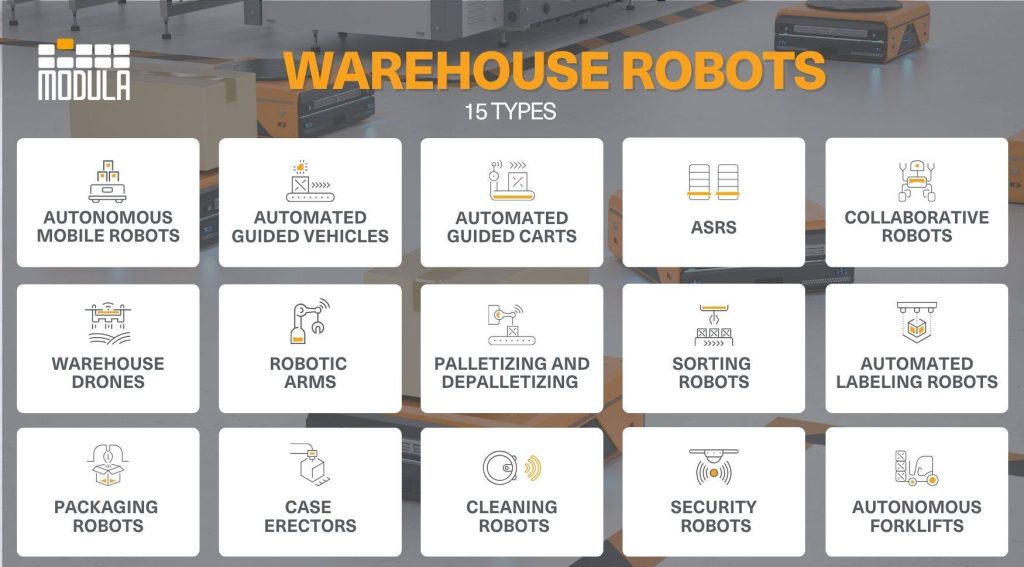
Warehouse robots can take many forms, from autonomous mobile robots and automated guided vehicles to automated storage and retrieval systems, robotic picking systems, and software-connected automation.
In this guide, we will:
- Explore the most common types of warehouse robots and how they support different warehouse tasks
- Explain how warehouse robotics technology works
- Review the key benefits of warehouse robots
- Look at how Modula’s automated warehouse solutions can support more efficient warehouse operations

Types of Warehouse Robots
Advancements in warehouse robotics technology have introduced specialized robots and automated systems for many different warehouse tasks, from moving inventory to storing, picking, sorting, packing, and tracking goods.
The most common types of warehouse robots include:
Autonomous Mobile Robots (AMRs)
Autonomous mobile robots (AMRs) (AMRs) are advanced robots that can navigate a warehouse independently, without relying on fixed paths or constant human control.
AMRs use technologies such as sensors, cameras, laser scanners, mapping software, and in some systems, artificial intelligence to understand their surroundings and adjust their routes in real time.
This allows them to avoid obstacles, move around people and equipment, and support tasks such as transporting totes, cartons, or materials between storage areas, picking stations, packing zones, and shipping areas.
Automated Guided Vehicles (AGVs)
Automated guided vehicles (AGVs) are warehousing robots that move materials through a facility by following predefined routes.
AGVs typically navigate using technologies such as wires, magnetic tape, sensors, lasers, or markers installed in the warehouse environment.
Unlike AMRs, which can adjust their routes more dynamically, AGVs usually operate along fixed paths.
This makes them useful for repetitive material handling tasks where the workflow is consistent and predictable, such as moving pallets, carts, or loads between production, storage, and shipping areas.
Automated Guided Carts (AGCs)
Automated guided carts, or AGCs, are compact automated vehicles used to transport lighter loads, such as totes, parts, or small components, within a warehouse or production facility.
They typically follow set routes using guidance technologies such as magnetic tape, RFID tags, sensors, or other markers.
Because they are smaller and lower-profile than AGVs, AGCs are often used to support repetitive point-to-point transport tasks, such as delivering parts to workstations or moving materials between storage and production areas.
Automated Storage and Retrieval Systems (ASRS)
Automated storage and retrieval systems (ASRS) are computer-controlled systems designed to automatically store and retrieve items from storage locations within the warehouse.
When integrated with a warehouse management system (WMS), automated storage and retrieval systems can identify where inventory is stored, retrieve the correct item, and deliver it to an operator or workstation for picking, replenishment, or order fulfillment.
ASRS solutions can include vertical lift modules, horizontal carousels, tote shuttles, mini-load systems, unit-load systems, and other automated storage technologies
Collaborative Robots (Cobots)
Collaborative robots, also known as cobots, are advanced robotic systems designed to work safely
alongside humans in the warehouse.
In warehouse environments, cobots can support tasks such as picking, packing, sorting, palletizing, quality checks, and machine tending.
They are often equipped with sensors, force-limiting technology, and safety features that help them detect nearby operators and reduce the risk of contact-related injuries.
Cobots are commonly used for repetitive or ergonomically challenging tasks, helping employees work more efficiently while reducing manual strain.
Unmanned Aerial Vehicles (UAVs)
Unmanned aerial vehicles (UAVs)are also known as warehouse drones. In warehouse operations, they are most often used to support inventory tracking, cycle counting, inspection, and monitoring tasks.
Equipped with cameras, sensors, barcode scanners, or RFID readers, warehouse drones can scan inventory in hard-to-reach areas and help identify stock discrepancies with less manual effort.
Because they can move through aisles and access higher storage locations, UAVs can be especially useful in large warehouses or distribution centers where manual inventory checks are time-consuming.
Anthropomorphic Robots
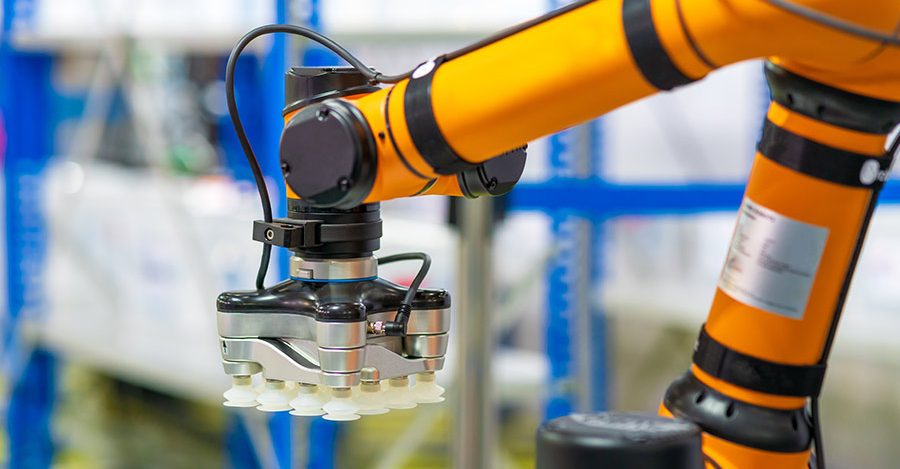
Anthropomorphic robots are robotic systems designed to perform movements similar to human arms or hands. In warehouse operations, they often use robotic arms, grippers, cameras, sensors, and vision technology to identify, pick, place, sort, or pack items with speed and consistency.
These robots are especially useful for repetitive handling tasks, particularly when products are consistent in size, shape, weight, or packaging.
When integrated with automated storage systems, conveyors, or warehouse software, anthropomorphic robots can help reduce manual handling and improve throughput in high-volume operations.
Palletizing and Depalletizing Robots
Palletizing robots automatically stack products, cartons, or cases onto pallets in a consistent and organized pattern.
Depalletizing robots perform the opposite task, removing items from pallets and placing them onto conveyors, workstations, or other handling systems.
These robots often use robotic arms, grippers, sensors, and programming logic to handle products with different sizes, weights, and shapes.
By automating repetitive lifting and stacking tasks, palletizing and depalletizing robots can improve throughput, reduce product damage, and lower the risk of manual-handling injuries.
Sorting Robots
Sorting robots identify, categorize, and route items to the correct location within a warehouse or fulfillment center.
These systems may use sensors, barcode scanners, cameras, computer vision, and software logic to recognize products and determine where they should go next.
In high-volume operations, sorting robots can help move orders more quickly through the fulfillment process, reduce manual sorting errors, and support faster shipping workflows.
Automated Labeling Robots
Automated labeling robots help warehouse operators apply labels to products, cartons, pallets, or packages with speed and consistency.
These systems use precision applicators to place labels in the correct position. They can also use sensors and cameras to detect the product’s location and orientation, allowing the label to be applied accurately.
By automating label placement, warehouses can reduce manual work, improve labeling consistency, and support faster packing and shipping workflows.
Packaging Robots
Packaging robots help automate packaging tasks such as packing, wrapping, sealing, or preparing products for shipment.
Depending on the application, these systems can use robotic arms, grippers, sensors, conveyors, wrapping equipment, or sealing mechanisms to handle products and packages consistently.
By automating repetitive packaging tasks, warehouses can reduce manual labor, improve packaging consistency, limit material waste, and keep products moving efficiently toward shipping.
Case Erectors
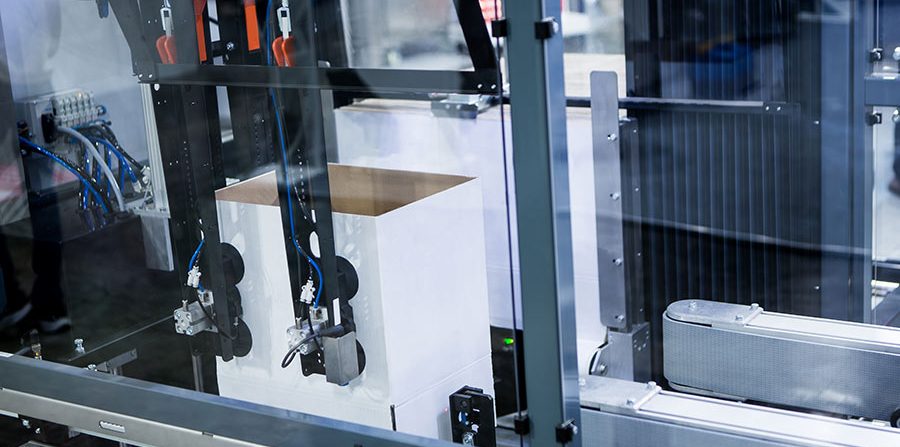
Case erector robots automate the process of forming flat cardboard blanks into boxes so they are ready for packing.
These systems typically use grippers, suction cups, mechanical arms, conveyors, and tape or sealing mechanisms to open, shape, and secure each case.
This helps packaging lines maintain a steady flow of ready-to-fill boxes, while reducing the repetitive manual effort required to set up cartons by hand.
Cleaning Robots
Cleaning robots help maintain cleanliness and hygiene standards in warehouses, distribution centers, and production facilities.
These systems can include autonomous floor scrubbers, vacuuming robots, and disinfection robots equipped with brushes, vacuum systems, sensors, and navigation technology.
In busy facilities, cleaning robots can support regular floor care with less disruption to daily operations, helping keep work areas safer and easier to navigate.
Security Robots
Security robots help monitor warehouse facilities by providing continuous surveillance and alerts for unusual activity, unauthorized access, or potential safety issues.
These robots can be equipped with cameras, motion sensors, sound sensors, night vision, thermal imaging, or 360-degree viewing capabilities to monitor different areas of the facility.
In large warehouses or distribution centers, security robots can support facility monitoring during and after operating hours, helping teams identify issues more quickly and maintain better visibility across the site.
Autonomous Forklifts
Autonomous forklifts are robotic vehicles designed to move pallets, containers, or other heavy loads without constant manual operation.
They use sensors, cameras, navigation technology, and onboard software to travel through warehouse aisles, pick up loads, avoid obstacles, and deliver materials to designated locations.
In warehouse and manufacturing environments, autonomous forklifts can support repetitive pallet transport, reduce forklift travel for operators, and improve material flow between receiving, storage, production, and shipping areas.
How Warehouse Robotics Technology Works
Warehouse robotics technology combines hardware, software, sensors, and real-time data to help robots move, identify items, avoid obstacles, and complete assigned tasks.
Some robots follow fixed routes, while others can map their surroundings and adjust their path as conditions change.
In many warehouse environments, robots also connect with warehouse software to receive tasks, update inventory records, and coordinate with other automation systems.
Here are some of the key technologies that help warehouse robots operate effectively:

Artificial Intelligence (AI)
Artificial intelligence can help some warehouse robots analyze data, recognize patterns, and make decisions based on real-time conditions.
In warehouse robotics, AI may support tasks such as route optimization, object recognition, product identification, picking decisions, and traffic management.
For example, an autonomous mobile robot may use AI-powered software to identify the most efficient route through a busy warehouse, while a robotic picking system may use vision technology and machine learning to recognize and handle specific products.
LiDAR Technology
LiDAR, or Light Detection and Ranging, helps warehouse robots measure distances and understand their surroundings using laser pulses.
The system can create detailed maps of the warehouse environment, allowing robots to:
- Detect obstacles
- Navigate aisles
- Avoid collisions
- Reroute around congestion
LiDAR is especially useful in busy warehouse environments where people, forklifts, pallets, and other equipment may be moving through the same areas.
Sensors and Cameras
Warehouse robots rely on sensors and cameras to monitor their surroundings, detect movement, verify products, and operate safely around people, equipment, and inventory.
Leading technologies include:
- Proximity sensors
- Barcode scanners
- RFID readers
- Depth cameras
- Infrared sensors
These tools help robots detect nearby objects, track inventory, and verify products during picking and sorting tasks.

Navigation and Mapping
Many warehouse robots use navigation and mapping technology to understand where they are, where they need to go, and how to move through the facility safely.
Some autonomous robots use simultaneous localization and mapping, or SLAM, to create and update warehouse maps in real time.
This allows them to adjust their routes when obstacles, traffic, or workflow changes occur.
Think of it as warehouse GPS with live route updates.

Real-Time Connectivity
Warehouse robots are typically connected to warehouse management systems (WMS), inventory software, or fleet management platforms to receive tasks and share operational data.
This connectivity allows robots and automated systems to:
- Receive picking, transport, or replenishment tasks
- Update inventory records in real time
- Coordinate with other robots or automation equipment
- Share performance and status data with warehouse teams
When robots are connected to warehouse software, facilities can better coordinate movement, picking, storage, and fulfillment across the operation.
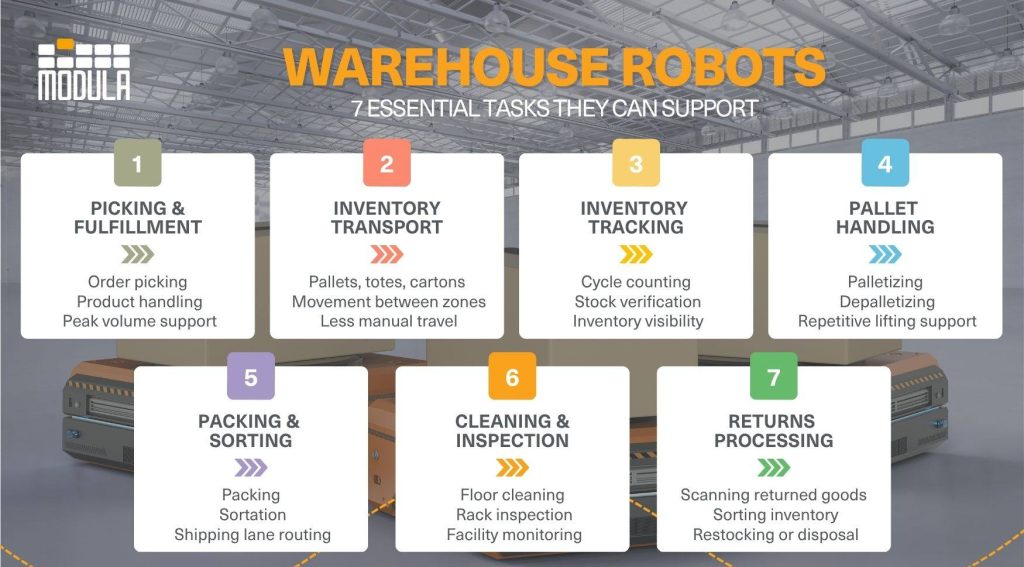
7 Essential Tasks Warehouse Robots Handle
Warehouse robots can support many operational tasks beyond simple material transport.
Depending on the technology, they may assist with picking, inventory movement, cycle counting, pallet handling, sorting, cleaning, inspection, and returns processing.
As warehouse workflows become more complex, robotics can take on repetitive, physically demanding, or time-sensitive activities that often create bottlenecks.
This allows employees to focus on tasks that require judgment, problem-solving, or customer-specific handling, while automated systems keep routine processes moving.
Picking and Order Fulfillment
One of the most common uses for warehouse robots is assisting with order picking and order fulfillment.
Autonomous mobile robots can transport products, totes, or carts to employees, while robotic picking systems can identify, pick, and place items using vision technology, grippers, or suction tools.
Use case: Automated warehouses for eCommerce fulfillment often use warehouse picking robots to manage spikes in order volume during peak shopping seasons.
Inventory Transport
Some warehouse robots are designed to move pallets, totes, cartons, or materials across the facility so employees do not have to rely on manual carts, forklifts, or repeated travel for every movement.
AGVs, AMRs, autonomous forklifts, and other transport robots can move inventory between storage zones, picking stations, production areas, packing lines, and shipping areas.
This helps lower congestion while keeping inventory flowing smoothly across operations.
Use case: Manufacturing facilities often use transport robots to move materials between production lines and storage areas.
Inventory Tracking and Cycle Counting
Keeping track of inventory manually can take time, especially in large facilities.
That’s why some warehouses use robots equipped with cameras, barcode scanners and RFID technology to monitor stock levels in real time.
These robots can scan shelves, detect misplaced inventory and identify low-stock items with minimal employee involvement.
Use case: Large distribution centers use inventory robots to improve stock accuracy and lessen manual cycle counting.
Palletizing and Depalletizing
Palletizing and depalletizing robots can take on repetitive lifting and stacking tasks that are physically demanding for employees.
According to OSHA, repetitive lifting and handling heavy loads can increase the risk of workplace strain and musculoskeletal disorders (MSDs).
Palletizing robots automatically arrange products, cases, or cartons onto pallets in a consistent pattern, while depalletizing robots unload items from pallets and place them onto conveyors, workstations, or other handling systems.
These systems are especially useful in high-volume operations where consistent pallet handling can help improve throughput, reduce product damage, and support safer material handling.
Use case: Food and beverage facilities often use palletizing robots for high-volume case handling.
Packing and Sorting
Warehouse robots can also automate sorting and packaging workflows.
AI-powered sortation systems identify products, route orders and direct packages to the correct shipping lanes with high accuracy. These systems are especially useful in operations handling thousands of orders per day.
Use case: Parcel and eCommerce fulfillment hubs use robotic sortation systems to speed up shipping operations.
Warehouse Cleaning and Inspection
Some warehouse robots are designed to support facility maintenance, cleaning, and inspection tasks.
Autonomous floor-cleaning robots can help keep warehouse floors clear and easier to navigate, while drones or inspection robots can monitor racks, equipment conditions, and hard-to-reach areas.
In large warehouses or high-traffic facilities, these systems can help teams maintain safer, cleaner work areas without pulling employees away from core operational tasks.
Use case: Large warehouses use inspection drones to identify maintenance issues and monitor rack safety.
Returns Processing
Returns processing is another area where warehouse robots can support more efficient material flow, especially during seasonal peaks or high-volume return periods.
Robotic systems can help transport returned items, scan products, and sort inventory for restocking, refurbishment, repair, recycling, or disposal.
In retail and eCommerce fulfillment centers, these systems can help keep reverse logistics workflows organized and reduce the manual effort required to process returned goods.
Benefits of Warehouse Robotics
Warehouse robots are quickly becoming the multitaskers of smart warehousing, helping improve everything from efficiency to workplace safety.
From faster workflows to safer operations, leading benefits include:
- Increased productivity: Robots can take on repetitive activities and keep routine workflows moving with less interruption, especially in picking, transport, packing, and fulfillment.
- Better use of warehouse space: Automated storage and retrieval systems can use vertical height more effectively, helping facilities reduce the floor space required for storage.
- Improved employee safety: Robots can reduce exposure to physically demanding tasks, including repeated lifting, long walking distances, and manual material handling.
- Higher picking accuracy: Robotics and software-connected automation can guide operators, verify inventory, and limit errors during picking, sorting, and order fulfillment.
- Greater scalability: Many robotic systems can be expanded, reconfigured, or adapted as order volumes, product mixes, and operational needs change.
- Improved inventory visibility: When connected to warehouse software, robots and automated systems can update stock movements, track product locations, and provide more reliable operational data.
- More efficient reverse logistics: Robots can assist with returns by moving, scanning, sorting, and routing returned inventory through the correct process.
Warehouse Robotics ROI: What to Consider
Many warehouse automation projects are evaluated over a three-to-five-year ROI window, but the actual payback period depends on several factors, including labor costs, order volume, picking rates, space constraints, error rates, and the type of automation implemented.
For many facilities, the value of warehouse robotics goes beyond short-term labor savings.
Robots and automated systems can help improve throughput, reduce manual travel, increase accuracy, support safer workflows, and create a more scalable operation.
When evaluating ROI, it is important to look at both direct and indirect benefits, including productivity gains, space savings, inventory accuracy, reduced product damage, and the ability to manage growth without adding the same level of manual labor.
Want a closer look at the numbers? Explore our guide to warehouse automation ROI to see how automation can impact labor costs, productivity, and long-term operational efficiency.
Automated Warehouse Solutions from Modula
At Modula, we help warehouses improve storage, picking, material flow, and inventory management through automated storage solutions and software-connected systems.
Our solutions are designed to reduce wasted space, limit unnecessary operator travel, improve picking accuracy, and make day-to-day warehouse operations more efficient.
Modula automated warehouse solutions include:
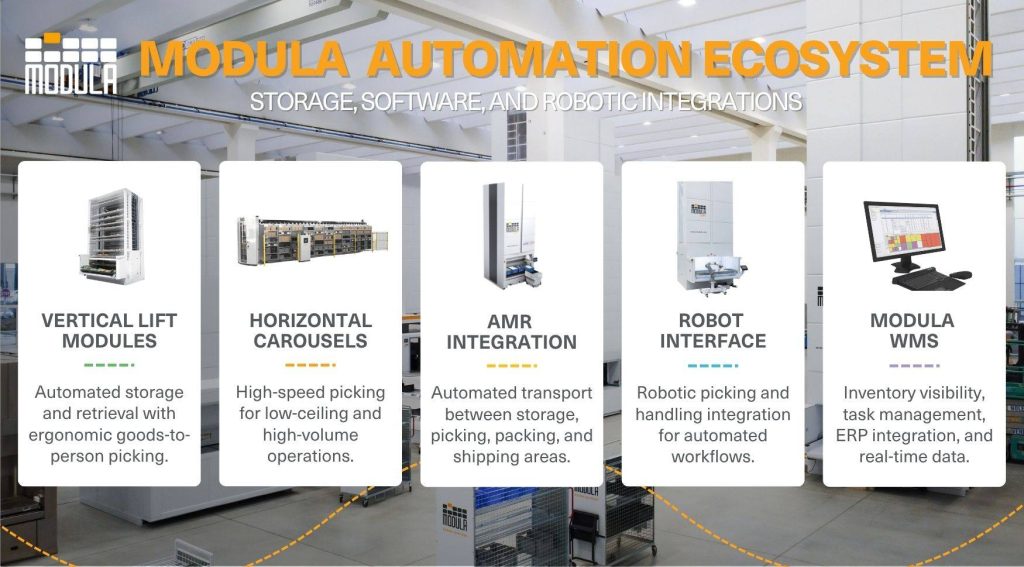
Modula Vertical Lift Modules
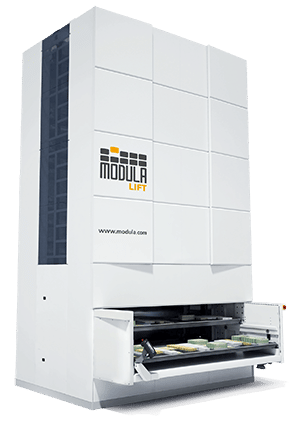
Modula Vertical Lift Modules are automated storage and retrieval systems that store items vertically and deliver the required tray, bin, or load to the operator at an ergonomic picking bay.
By using the available ceiling height, Modula VLMs can help facilities recover floor space, organize inventory more efficiently, and reduce the time employees spend walking, searching, reaching, or bending during picking and replenishment.
Modula offers several vertical storage solutions designed for different inventory types, load requirements, security needs, and throughput levels:
Modula Lift: A flexible vertical lift module designed to store trays of parts, tools, components, finished goods, and other inventory while improving space utilization and picking efficiency.
Modula Slim: A compact vertical storage solution for facilities that need automation in a smaller footprint or narrow space.
Modula Next: A secure vertical lift module designed for controlled access to individual compartments, making it useful for high-value, restricted, or sensitive inventory.
Modula Pallet: A vertical storage solution designed to store and retrieve pallets or heavy loads at ground level, helping reduce forklift use and improve pallet handling safety.
Modula Flexibox: A high-throughput vertical storage solution for bins, designed to support faster picking and efficient handling of small parts, totes, and high-volume order profiles.
For environments with specific storage requirements, Modula also offers Clean Room and Temperature Control solutions to help protect sensitive products and support controlled operating conditions.
Modula Horizontal Carousels
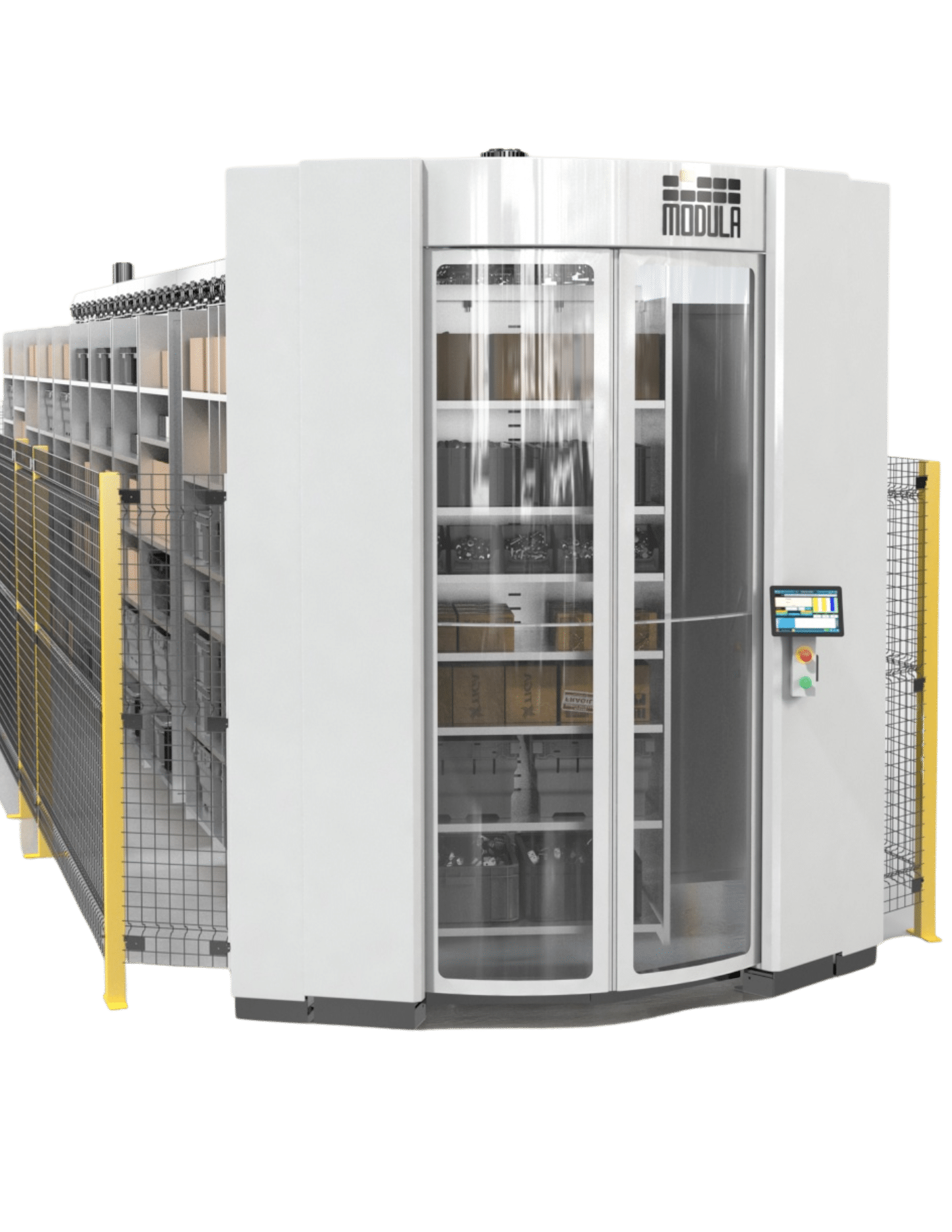
Modula Horizontal Carousels are automated storage systems designed for fast, goods-to-person picking in facilities with lower ceiling heights or high order-picking requirements.
The system uses rotating bins that move horizontally along an oval track, automatically delivering the required inventory to the operator at the picking station.
By bringing items directly to the operator, Modula Horizontal Carousels can help reduce walking time, improve picking accuracy, and support faster fulfillment in production, distribution, and spare parts environments.
They are especially useful for facilities that need high-speed picking but cannot use vertical height in the same way as a vertical lift module.
Modula Robotic Integrations
Modula solutions can integrate with different types of warehouse robots to further automate material handling, picking, and order fulfillment workflows.
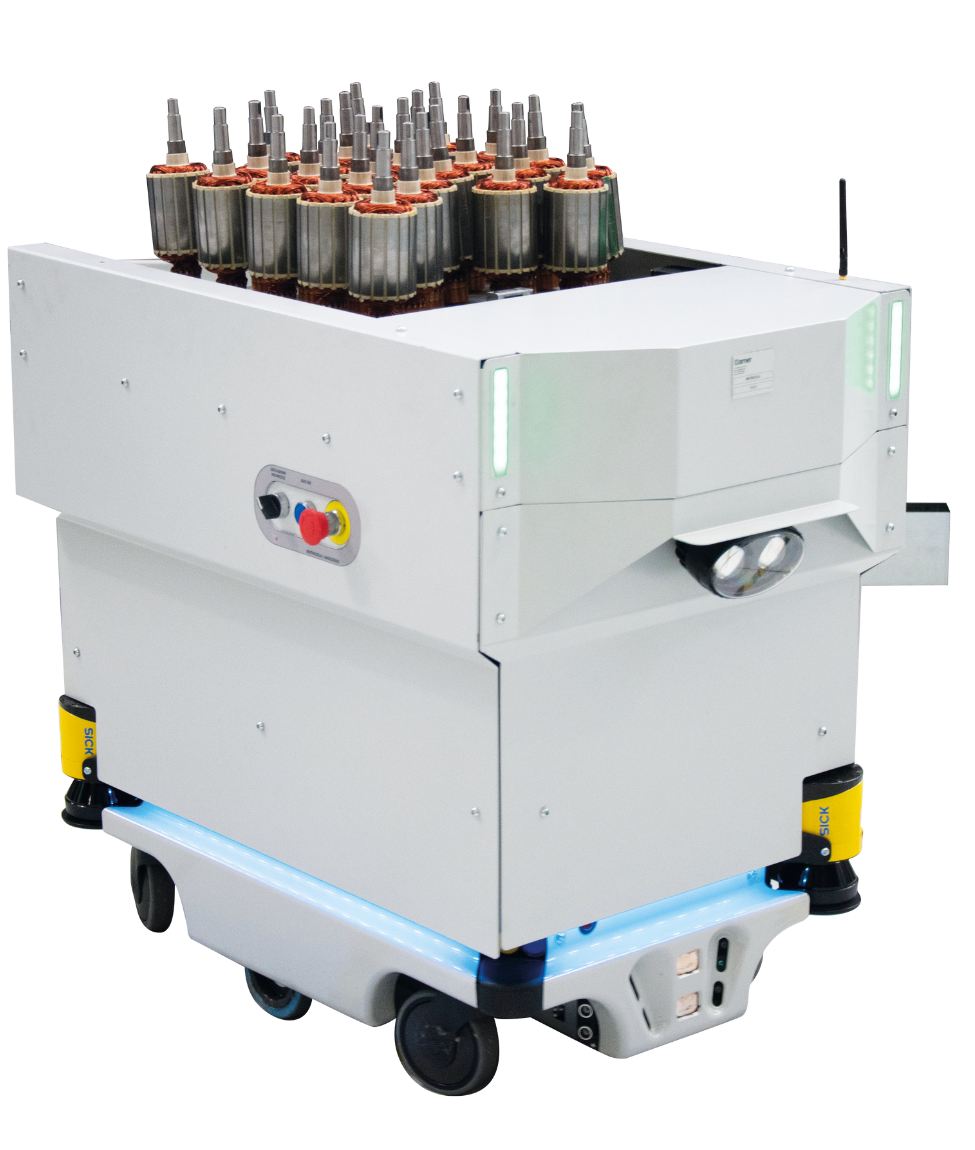
AMR integration: Modula systems can connect with autonomous mobile robots to move items between automated storage equipment, picking stations, packing areas, and other warehouse zones. This helps reduce manual transport and supports a more efficient flow of materials across the facility.
Robot Interface: Modula also offers a Robot Interface that allows robotic systems to interact with Modula machines for automated picking and handling tasks. This can support partially or fully automated workflows, depending on the facility layout, product type, and level of automation required.
When combined with warehouse software, these robotic integrations can help coordinate storage, picking, transport, and fulfillment processes more efficiently.
Check out the video below to see our robot integration in action:
Modula WMS
Modula WMS helps connect automated storage systems, operators, inventory data, and warehouse workflows in one software environment.
When used with Modula solutions, the WMS can help manage inventory locations, guide picking and replenishment tasks, update stock movements, and support integration with ERP or other warehouse systems.
For facilities using robotics or other automation technologies, warehouse software plays an important role in coordinating tasks, improving visibility, and keeping storage, picking, and fulfillment processes aligned.
Warehouse Robotics: Key Takeaways
- Warehouse robots and automated systems can support storage, retrieval, transport, picking, sorting, packing, inventory tracking, cleaning, security, and returns processing.
- Different technologies are designed for different workflows. AMRs and AGVs support transport, ASRS solutions automate storage and retrieval, robotic arms assist with handling tasks, and software-connected systems coordinate activity across the facility.
- For many operations, warehouse robotics is not about replacing employees. It is about reducing repetitive manual work, improving accuracy, supporting safer processes, and helping teams manage higher order volumes.
- The right solution depends on the facility layout, inventory profile, order volume, labor needs, software requirements, and long-term growth plans.
Warehouse Robotics: FAQs
What can warehouse robots do?
Warehouse robots can support a wide range of warehouse tasks, from picking and inventory transport to cycle counting, palletizing, packing, sorting, cleaning, inspection, and returns processing.
| Task | Robot Type | What It Does | Common Use Case |
|---|---|---|---|
| Picking and fulfillment | AMRs and warehouse picking robots | Brings inventory to pickers and assists with sorting | eCommerce fulfillment centers |
| Inventory transport | AMRs, AGVs, and autonomous forklifts | Moves pallets, totes, and cartons across the warehouse | Manufacturing and distribution facilities |
| Inventory tracking | Inventory robots and drones | Scans shelves and tracks inventory levels | Large distribution centers |
| Palletizing | Robotic palletizers | Stacks and unloads products automatically | Food and beverage warehouses |
| Packing and sorting | Packaging and sortation robots | Routes packages to shipping lanes | Parcel and shipping hubs |
| Cleaning and inspection | Drones and cleaning robots | Monitors racks and cleans floors | Large warehouse facilities |
| Returns processing | Reverse logistics robots | Sorts and scans returned inventory | Retail fulfillment centers |
Can warehouse robots operate in any environment?
Warehouse robots are primarily designed for indoor environments with controlled conditions.
Their suitability depends on the type of robot, facility layout, temperature, humidity, floor conditions, product type, and operational requirements.
For facilities with sensitive products or specific environmental needs, automated storage solutions can also be configured for controlled environments, such as clean rooms or temperature-controlled applications.
How do you maintain warehouse robots?
- Perform physical inspections: Regularly check the robot for visible signs of wear, damage or misalignment by inspecting the wires, joints, end effectors, wheels or tracks.
- Install software updates: Like any computerized system, robots require periodic software updates to fix bugs and boost their performance.
- Regularly clean the robots: Dust, dirt, and debris can affect sensors, cameras and mechanical parts. Regularly cleaning these parts ensures optimal efficiency.
- Lubricate the robots: Mechanical joints and moving parts may need periodic lubrication to reduce wear and tear and ensure smooth movement.
- Inspect the power systems: Ensure that charging systems, cords and connections are in good condition. Faulty power systems can lead to inefficient robot operation or sudden shutdowns.
Can warehouse robots work with a WMS?
Yes. Many warehouse robots and automated systems can connect with a warehouse management system or other warehouse software.
This allows them to receive tasks, update inventory records, coordinate with other equipment, and provide real-time operational data.