A 101 Guide to B2B Fulfillment: Best Practices & FAQs
B2B fulfillment underpins supply chain operations between manufacturers, wholesalers, and retailers, where accuracy, scale, and consistency often outweigh speed.
According to the International Trade Administration, the global B2B eCommerce market was projected to reach $36 trillion by 2026, a scale that leaves little room for error in how orders are fulfilled.
For warehouse managers, growth brings a new set of challenges. Larger orders, stricter compliance requirements, and partner-specific delivery standards all add complexity to day-to-day fulfillment.
At the same time, fulfillment is no longer judged on efficiency alone.
As customer expectations continue to rise, businesses are expected to deliver a seamless experience alongside operational excellence.
In fact, a recent report found that 65% of B2B organizations consider customer experience a top priority.
By the end of this guide, you will:
- Understand the key differences between B2B and B2C fulfillment
- Discover best practices for managing inventory, recurring orders, and compliance
- Explore how warehouse automation tools like Modula WMS can streamline bulk order processing, improve compliance, and ensure accurate, on-time delivery at scale

Understanding B2B Fulfillment
In B2B fulfillment, you’re shipping products to other businesses, whether that’s big-box retailers, department stores, or smaller boutiques, not directly to consumers.
These orders are generally fulfilled in bulk and shipped via freight. However, smaller B2B orders can be sent through standard parcel carriers.
The goal is to help businesses stock their shelves and prepare for resale, whether through brick-and-mortar stores, eCommerce platforms, or other channels such as:
- Third-party marketplaces
- Subscription boxes
- Wholesale distribution networks
A B2B fulfillment center plays a critical role by serving as a centralized hub to manage inbound freight, inventory storage, outbound shipments, and documentation.
How B2B Fulfillment Services Differ From B2C: Key Differences
When it comes to order fulfillment, B2B and B2C operations follow very different models tailored to their unique customer needs.
Understanding these distinctions is essential for companies aiming to optimize logistics, scale operations, and improve customer satisfaction.
| Category | B2B Fulfillment | B2C Fulfillment |
|---|---|---|
| Order volume | Larger quantities, fewer orders. Bulk shipments are placed every few weeks or months. | Smaller, more frequent orders shipped directly to consumers |
| Shipping method | Typically shipped via freight and palletized, though smaller orders might be sent by parcel if properly boxed | Typically shipped via parcel to residential addresses |
| Regulations | Must meet strict industry standards, including hazmat, EDI, international rules, and more | Fewer compliance requirements |
| Cost | Higher due to size, labor, and specialized warehouse equipment | Lower, with minimal handling and faster turnaround time |
| Fulfillment speed | Time-sensitive. Guaranteed delivery dates are key for inventory planning. | Fast shipping matters, but urgency is driven by customer expectations |
| Customer relationship | Long-term contracts with negotiated terms and dedicated account management | Transactional, with less direct contact |
| Returns | Fewer returns, but complex; might involve RMAs or pallet-level restocking | Frequent returns; requires fast, simple return processing |
| Technology | Integrates with ERPs, EDI systems, and supply chain software | Runs on eCommerce platforms and API-based tools for quick fulfillment |
| Packaging | Bulk or industrial packaging, often customized by retailer or distributor needs | Branded, consumer-friendly packaging optimized for individual shipping |
| Payment terms | Invoicing, credit terms, and purchase orders | Immediate payment via credit card, PayPal, or digital wallets |
How Does B2B Order Fulfillment Services Work?
B2B order fulfillment goes beyond shipping bulk orders. It’s a strategic logistics operation designed to:
- Uphold supply chain reliability
- Meet complex compliance standards
- Support long-term business partnerships
It demands precise inventory management, scheduled delivery windows, and adherence to regulations that vary by product, region, and retailer.
Modern B2B fulfillment and distribution operations often rely on integrated systems that can support high-volume shipments while maintaining visibility and control.
Here’s how the process works:
Order Initiation via Contract or Portal
Business clients place orders through EDI systems, procurement portals, or directly with account reps, typically under long-term contracts that define delivery schedules, pricing, and volume commitments.
Inventory Allocation and Prep
Inventory is pulled from bulk storage zones or reserved stock.
Orders might require prep steps like kitting, custom labeling, or packaging to meet the receiving company’s specific compliance rules or retail display standards.
Compliance and Documentation
B2B order fulfillment often involves regulated goods, such as electronics, chemicals, or pharmaceuticals, which require documentation such as MSDS sheets, export forms, or hazmat endorsements.
Missing or incorrect paperwork can delay delivery and lead to chargebacks or costly penalties.
A recent analysis found that chemicals and petrochemicals made up 35% of the U.S. hazardous goods logistics market, with non-compliance driving major investment in tracking and documentation systems.
Consolidated Packing and Freight Prep
Orders are typically packed in bulk, palletized, and prepared for LTL or FTL freight. Shrink-wrap, corner protectors, and barcode labeling are often used to maintain product integrity through transit.
Freight Scheduling and Delivery Coordination
Most B2B orders are not drop-off deliveries because they require coordination with loading docks, appointment windows, and receiving protocols.
Deliveries must arrive on time to avoid disrupting the buyer’s supply chain.
Receiving and Inspection
Once delivered, the client inspects the shipment against packing slips and purchase orders. Errors here can lead to chargebacks or strained partnerships, making accuracy a top priority.
Invoicing and Payment Terms
Invoices are issued post-delivery, with terms ranging from Net 15 to Net 60.
Efficient fulfillment not only preserves the business relationship but ensures faster payment cycles and lower days sales outstanding (DSO).

B2B Fulfillment Center: In-House vs. 3PL
3Businesses can either manage fulfillment through their own B2B fulfillment center or outsource it to a third-party logistics (3PL) provider.
The right approach depends on factors like order volume, growth plans, and the level of operational control you need.
Here’s a closer look at how in-house fulfillment compares with outsourced B2B order fulfillment services:
| Factor | In-House B2B Fulfillment | 3PL B2B Fulfillment Services |
|---|---|---|
| Upfront investment | High due to warehouse space, equipment, and warehouse management system | Low; no facility or infrastructure to build |
| Control over process | Full control over every step of B2B order fulfillment | Shared control; relies on the 3PL’s systems and SLAs |
| Scalability | Limited by owned space and staffing capacity | Easier to scale up/down with order volume |
| Cost structure | Fixed costs regardless of order volume | Variable, pay-as-you-go pricing |
| Inventory Visibility | Full real-time visibility through internal systems | Depends on provider integrations and reporting capabilities |
| Speed to launch | Slower; requires hiring, setup, and systems integration | Faster since existing infrastructure is already in place |
| Compliance and partner requirements | Managed internally, requires in-house expertise | Handled by providers experienced in B2B fulfillment services |
| Ideal for | High-volume, established businesses with steady demand | Growing businesses needing flexible B2B order fulfillment services |
Best Practices for B2B Fulfillment Integration
Integrating B2B fulfillment into your warehouse operations takes more than just automation. It also takes accuracy, connectivity, and processes that can scale.
To achieve the fastest order fulfillment for B2B retailers, here’s what it takes to get B2B order fulfillment integration right:
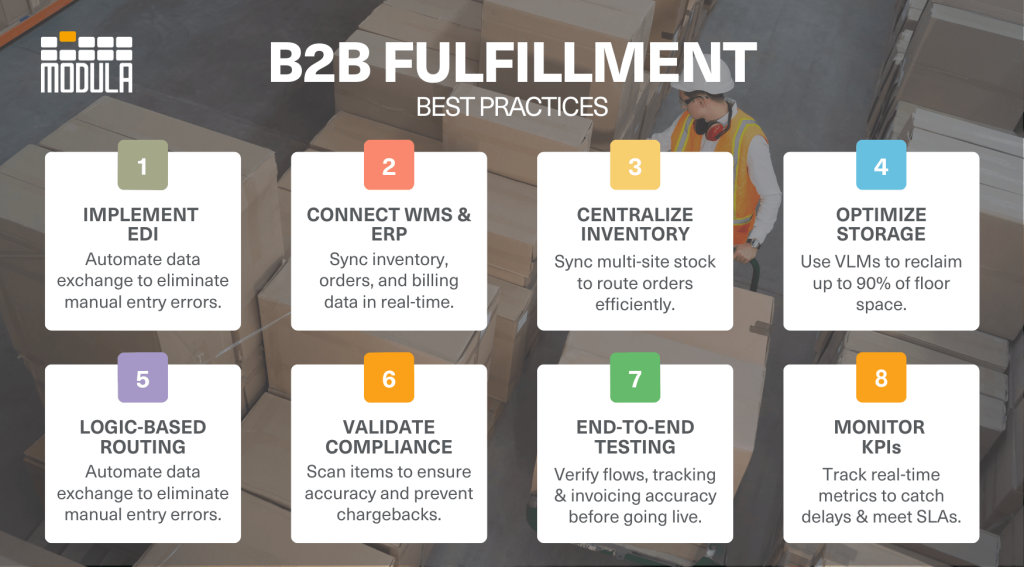
Use EDI for Standardized Data Exchange
Ensure your fulfillment system supports EDI formats (for example, 850 for purchase orders and 856 for advance ship notices) to automate communications with distributors, retailers, and suppliers.
A warehouse management system should be able to integrate with EDI platforms to reduce manual data entry and improve order accuracy.
Modula WMS supports these integrations, helping streamline communication across the supply chain.
Connect Your WMS to Your ERP and CRM
Integrate your warehouse management system with your existing ERP system to keep inventory, order status, and billing data in sync in real time.
Adding your CRM into the mix gives sales teams full visibility into fulfillment activity, making it easier to adjust forecasts and service levels on the fly.
For example, Modula WMS integrates with ERP systems to support real-time inventory visibility and coordinated warehouse operations.
Automate Inventory Syncing Across Locations
If you operate multiple warehouses or distribution centers, it’s critical to keep your inventory data synced in real time across all locations.
A warehouse management system with multi-site inventory capabilities helps prevent double-selling, backorders, and fulfillment delays, especially when B2B orders are tied to strict SLAs or scheduled restocks.
Modula WMS provides these capabilities across connected facilities.
This type of automation is still an exception and not a norm. According to a study, 36% of warehouse operations remain mostly manual, and just 10% are fully or semi-automated.
That gap presents a clear opportunity; integrated warehouse systems don’t just improve accuracy; they give you an edge in reliability and responsiveness.
Set Logic-Based Order Routing
Modern warehouse management systems can use routing rules to direct orders to the most appropriate picking zones, storage locations, or fulfillment centers based on business priorities such as inventory availability, order urgency, or shipping deadlines.
For example, Modula WMS, Plant Designer, and vertical lift modules (VLMs), can work together to optimize order routing and warehouse workflows.
Consider these:
- Route high-priority B2B orders to automated picking zones powered by Modula’s VLMs for faster, error-free fulfillment
- Send bulk SKUs to traditional pallet storage or manual pick zones using logic defined in Modula WMS
- Assign orders to the best-suited warehouse or fulfillment center based on proximity to the customer’s dock, current load balancing, or shipping cut-off times, all simulated in advance using Modula Plant Designer
Together, these tools help optimize throughput, reduce fulfillment time, and ensure every B2B shipment meets its service level agreement (SLA).
Validate Compliance During Pick and Pack
Barcode scanning, labeling, and workflow validation help ensure shipments meet customer-specific and regulatory requirements before leaving the warehouse.
Modula WMS supports barcode scanning, labeling, and system integration, making it easy to meet even the strictest B2B packaging and documentation requirements.
Modula’s real-time diagnostics and customizable workflows help catch issues, like GS1 labeling errors, hazmat tags, or missing export forms, before shipments leave the dock, reducing chargebacks and delays.
Conduct End-to-End Testing With Partners
Before going live, run test orders between your WMS, ERP, freight carriers, and customer portals.
Confirm that:
- Order data flows accurately
- Shipment tracking updates in real time
- Invoices reflect correct terms and line items
Monitor KPIs and Exceptions Instantaneously
Real-time warehouse analytics help monitor key fulfillment metrics, identify exceptions early, and support continuous process improvement.
Modula Web Analytics provides customizable dashboards and remote access to monitor order speed, fulfillment accuracy, inventory activity, and SLA performance.
With built-in alerts for exceptions, such as out-of-stock items, labeling issues, or delays, you can catch problems early and help keep your B2B commitments on track.
How To Manage Inventory for B2B Fulfillment
Managing inventory for B2B fulfillment goes beyond knowing what’s in stock.
You also need real-time visibility, accurate forecasting, and systems that keep inventory synchronized across warehouses and sales channels.
Here are a few practical ways to manage inventory more efficiently while supporting high-volume fulfillment.
Track Inventory in Real Time
Real-time inventory tracking gives you an accurate view of stock levels, helping prevent stockouts, overselling, and fulfillment delays.
A warehouse management system (WMS) updates inventory as products are received, picked, packed, and shipped, so every team works with the same information.
Forecast Demand and Maintain Safety Stock
Historical sales data, seasonal trends, and customer purchasing patterns can help you predict demand more accurately.
Keeping safety stock for high-demand SKUs also reduces the risk of running out of inventory when large or recurring orders come in.
Organize Inventory for Faster Picking
Store products based on order frequency, size, or customer requirements to reduce travel time during picking.
Grouping fast-moving skus together and assigning dedicated zones for contract customers can improve efficiency while minimizing picking errors.
Sync Inventory Across Systems
If you manage multiple warehouses or sell across different channels, your inventory data should stay synchronized in real time.
Integrating your WMS with your ERP, CRM, and EDI platforms helps ensure everyone works from the same inventory records.
Monitor Inventory Performance
Regularly review metrics such as inventory accuracy, stock turnover, carrying costs, order fill rate, and OTIF (On Time In Full) performance.
Monitoring these KPIs makes it easier to identify inefficiencies, adjust replenishment strategies, and improve overall fulfillment performance.
You need clear visibility into your performance. Tracking metrics like fulfillment accuracy, on-time delivery, and exception rates is essential for avoiding chargebacks.
B2B Order Fulfillment Services: 6 Critical Factors You Must Check
Choosing a B2B fulfillment partner isn’t just about fast shipping or low rates. It’s about finding a company who can handle the scale and complexity of your operations.
These are the essentials you don’t want to overlook:
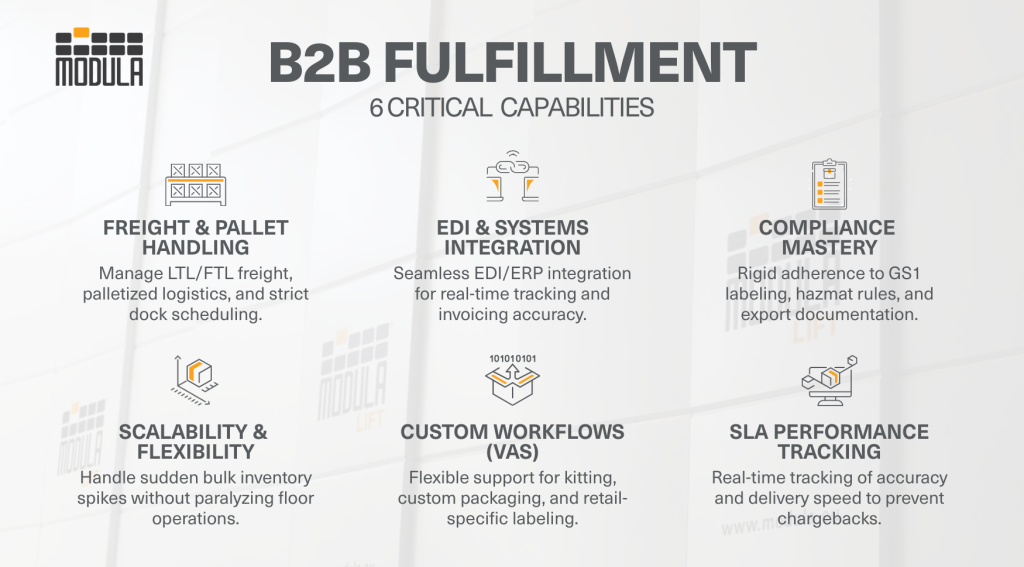
Freight and Pallet Handling
Look for providers with experience in freight coordination, including less than truckload (LTL) and full truckload (FTL) shipments, as well as palletized logistics.
Unlike small-parcel shipments, most B2B orders require dock scheduling, liftgate services, and bulk freight preparation.
EDI and Systems Integration
A strong B2B fulfillment partner should support EDI, ERP, and WMS integrations to ensure real-time order tracking, invoicing, and data accuracy across platforms.
If you’re unfamiliar with WMS integrations, our guide explains how they connect with other business platforms to keep fulfillment running smoothly.
Compliance Capabilities
From GS1 labeling and hazmat documentation to international export forms, the provider should have processes in place to meet industry and partner-specific compliance standards.
Scalability and Volume Flexibility
Choose a provider that can handle fluctuating order volumes, whether you’re scaling up for a new retail partnership or fulfilling seasonal purchase orders.
Custom Order Workflows
B2B fulfillment often involves kitting, custom packaging, or retail-compliant labeling. Make sure the provider can tailor workflows to meet your customers’ specific inbound requirements.
SLA Performance and Reporting
Your partner should offer clear metrics on fulfillment accuracy, on-time delivery, and exception reporting, ideally through a warehouse analytics platform that provides real-time dashboards and exception reporting, such as Modula Web Analytics.
B2B Fulfillment Services: Key Takeaways
- Unlike B2C, B2B fulfillment handles large, complex orders between businesses, requiring strict regulatory compliance and coordinated logistics
- B2B shipments often involve regulated goods like chemicals, electronics, or pharmaceuticals
- Missing MSDS sheets, export forms, or proper labeling can stall shipments or lead to penalties
- Warehouse management systems and warehouse automation improve inventory visibility, routing, and fulfillment performance
- Solutions such as Modula WMS, Vertical Lift Modules (VLMs), and Web Analytics help support these capabilities

B2B Fulfillment Services: FAQs
What is B2B fulfillment?
B2B order fulfillment is the process of preparing and delivering bulk orders between businesses.
It typically involves freight shipping, palletized handling, and strict regulatory compliance, supporting wholesalers, retailers, and distributors in stocking products for resale or internal use.
How does B2B fulfillment differ from B2C?
B2B order fulfillment manages large, recurring orders between businesses, like manufacturers shipping palletized goods to retailers.
It often involves freight shipping, EDI integration, and strict compliance requirements.
In contrast, B2C order fulfillment handles smaller, individual orders delivered directly to consumers, with faster turnaround and simpler packaging.
How to manage inventory for B2B fulfillment?
Effective inventory management for B2B order fulfillment starts with real-time visibility across storage locations.
Using a WMS like Modula WMS, businesses can:
- Track inventory levels
- Assign SKUs to specific zones
- Automate replenishment based on order frequency
Forecasting demand, allocating safety stock, and syncing systems with ERP and EDI platforms are also key to preventing stockouts and meeting SLA commitments.
What are the B2B fulfillment strategies for recurring orders?
Recurring B2B orders can benefit from automation and scheduling. Best practices include:
- Setting up standing purchase orders through EDI or customer portals
- Using a WMS to create pick-and-pack templates for repeat SKUs
- Allocating inventory zones for contract clients
- Leveraging Modula’s VLMs or automated systems for faster, repeatable workflows
- Using performance data to fine-tune delivery windows, staffing, and stock levels
These strategies help reduce manual work, improve accuracy, and strengthen B2B relationships through consistent service.