Agriculture Management Systems: Challenges, Benefits & FAQs
Agriculture Management Systems: Key Takeaways
- Optimize Dealership Parts Rooms: Upgrading to automated agricultural parts storage solutions reclaims up to 90% of floor space, allowing you to store heavy machinery components and small hardware efficiently.
- Eliminate Costly Mispicks: A connected dealership parts management system provides real-time tracking, ensuring the right parts are always available for service technicians during peak harvest seasons.
- Streamline Operations: Integrating a sophisticated agricultural warehouse management system with automated storage solutions drastically reduces picking times and minimizes equipment downtime for farmers.
According to recent market reports from the Association of Equipment Manufacturers (AEM), fluctuating commodity prices and economic pressures have led many farmers to defer purchasing new machinery. Instead, they are holding onto their existing equipment longer, which means the demand for maintenance, repairs, and spare parts has never been higher.
As the pressure shifts from the showroom floor to the service bay, the real bottleneck for many dealerships is now in the parts room.
When a tractor breaks down during the peak of harvest season, a farmer can’t afford to wait days for a repair. Efficiency and resilience are essential, especially when it comes to managing the agricultural dealership parts and inventory that keep heavy equipment moving.
However, that’s tough to do when mispicked or misplaced parts cause costly delays and disrupt service workflows. That’s where specialized inventory management software and targeted storage solutions come in.
In this article, we will:
- Share the top inventory challenges that agricultural equipment dealerships and manufacturers face.
- Discover why industry leaders are switching to automated software and agricultural parts storage solutions.
- Introduce you to the automated solutions that can help, including our Vertical Lift Modules and Warehouse Management System at Modula

Why Dealerships Are Upgrading Their Agricultural Parts Storage
With farmers keeping their machinery running longer, the volume of service tickets and parts passing through the dealership has multiplied.
Progressive American agricultural equipment manufacturers, suppliers, and dealers are meeting this demand by:
- Expanding storage capacities without building costly new facilities
- Minimizing inefficiencies in the parts room
- Improving materials handling speed and responsiveness for service technicians
Many are doing so by adopting modern agricultural parts management systems that combine physical agricultural equipment storage with real-time data to optimize operations.
But despite these advancements, a major source of inefficiency remains: outdated parts storage.
Many equipment dealerships still rely on static warehouse storage racks and manual picking, with no system in place to coordinate inventory or track parts instantaneously.
Workers spend valuable time walking aisles, reaching high shelves or crouching to retrieve items, tasks that slow down fulfillment and increase the risk of strain or error.
Automated agricultural warehouse systems solve these issues by automating part retrieval, validating picks, and optimizing workflows to improve both speed and safety.
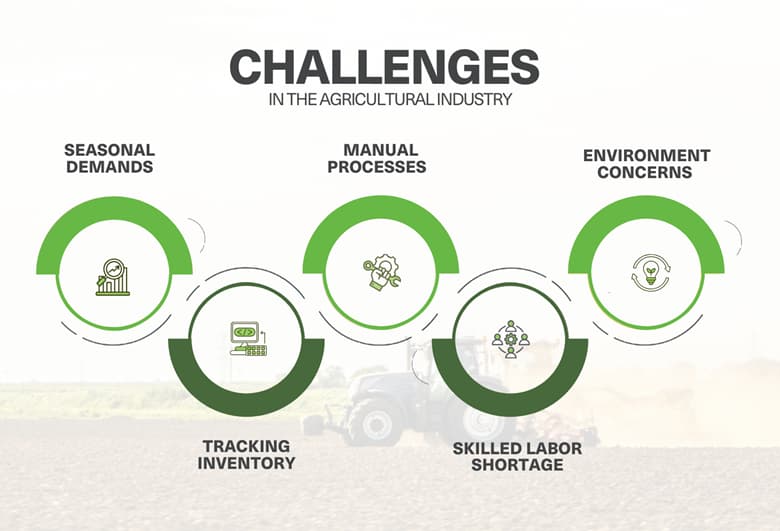
Challenges of Agricultural Parts Management
Managing agricultural parts often comes with challenges, which can significantly impact the efficiency and reliability of your operations, especially when supporting an aging fleet of machinery.
Seasonal Demands and Operational Strain
In agriculture, timing is everything, and that’s especially true when it comes to parts management.
During busy seasons like planting and harvesting, the demand for equipment repairs and maintenance skyrockets, putting serious pressure on dealerships to keep up.
A robust dealership parts management system helps dealerships stay ahead of these seasonal surges by forecasting demand, optimizing inventory, and ensuring the right agricultural dealership parts are available the second a technician needs them.
Here’s how to handle the seasonal rush:
- Use historical data to predict high-demand periods and plan inventory accordingly
- Implement just-in-time inventory strategies supported by real-time tracking tools
- Optimize workflows with software that integrates physical storage, service scheduling, and inventory replenishment
Tracking a Highly Diverse Inventory
From massive combine blades to tiny nuts and bolts, agricultural parts are incredibly diverse in size, shape, and weight. Dealerships must manage thousands of different SKUs just to keep daily operations running.
According to a recent survey conducted by Farm Equipment Magazine, over 60% of agricultural equipment dealerships report difficulties in accurately tracking and managing their parts inventory because there are just so many different parts to keep track of.
That’s where modern agricultural equipment parts inventory comes in; it offers real-time visibility and organized tracking across thousands of SKUs.
To track your agricultural parts in real time, it’s important to pair manual checks with digital tools:
- Conduct regular physical stock checks, either monthly or quarterly, and compare these counts with your system records
- Use a warehouse management system (WMS) to obtain real-time updates on inventory levels, movement and location
- Equip your inventory items with barcode or RFID tags and use scanners to accurately track each item’s movement

Manual Processes and Inefficiencies
Farmers rely on every hour in the field, especially during planting and harvesting. A broken vehicle or missing blade can bring operations to a halt, and a mispicked part by a dealership only adds costly delays.
Dealerships that send the wrong parts risk more than downtime; they risk losing trust.
Traditional warehouses make these mistakes more likely. Without a centralized inventory management system, inventory tracking is manual, slow, and often inaccurate.
A manager might check stock at 9 a.m., but without instant updates, they have no idea what’s actually available by 3 p.m.
To prevent mispicks:
- Regularly train warehouse staff on proper picking procedures and the use of any related technology
- Adopt visual picking technology (like LED pointers) so employees can pick accurately without second-guessing.
- Implement an agricultural warehouse management system to gain a comprehensive, real-time view of your ag parts inventory across your operation.
Skilled Labor Shortage
Skilled technicians and reliable warehouse staff are becoming harder to find and keep. When highly paid service technicians have to wait around for warehouse staff to find a lost part, dealership profitability plummets.
To attract skilled labor:
- Invest in automated storage and retrieval systems (AS/RS) and robotics, key components of modern agricultural parts storage solutions, to handle repetitive tasks and ease the strain on manual labor
- Implement inventory management software to improve tracking, replenishment, andorder fulfillment processes
Storing Heavy and Irregular Parts
Tractor parts storage involves heavy, bulky, and awkwardly shaped items, from massive engine blocks to long combine belts. Traditional static shelving wastes massive amounts of vertical space because shelves must be spaced far apart to accommodate the largest items, leaving mostly “air” in between.
Furthermore, trying to retrieve a 50-pound gear from a top shelf using ladders poses a severe safety hazard.
To handle heavy and irregular parts safely and efficiently:
- Adopt Vertical Lift Modules (VLMs): Bring heavy components directly to a waist-height picking bay, completely eliminating the need for bending, reaching, or climbing.
- Maximize vertical space: Use systems with dynamic tray height allocation to perfectly fit bulky items without wasting an inch of space.
- Integrate lifting aids: Pair your automated storage with hoists or manipulators to easily move heavy engine parts directly to the service cart.
Managing “Dead Stock” and Slow-Moving Items
Because farmers often keep reliable tractors running for decades, dealerships are forced to hold parts for machines that are 20 or 30 years old. Over time, this creates a massive accumulation of “dead stock”, parts that are rarely requested but take up valuable bin space.
Without a smart Ag parts inventory strategy, these obsolete parts clutter the warehouse, making it harder and slower to access the fast-moving items needed for daily service tickets.
To handle slow-moving parts efficiently:
- Consolidate inventory: Move slow-moving items into high-density automated storage to clear up your easily accessible floor space for fast-moving seasonal items.
- Leverage data: Use your dealership parts management system to identify which parts haven’t moved in over 12 months, allowing you to make informed decisions about liquidation.
- Group by frequency: Organize your WMS so that high-demand items are kept closest to the retrieval bay, while obsolete parts are automatically stored higher up in the machine.
Securing High-Value Precision Ag Components
Modern agriculture is highly technological. Today’s heavy equipment relies on expensive GPS monitors, precision farming displays, and sensitive sensors. Leaving these high-value electronics on open static shelving exposes them to dust, humidity, and the risk of shrinkage (loss or theft).
Advanced agricultural equipment storage isn’t just about saving space; it’s about protecting your most expensive, fragile inventory from the rugged environment of a dealership.
To protect high-value components:
- Implement secure access: Use automated storage systems that require an RFID badge or specific login credentials to retrieve expensive electronics.
- Enclose your inventory: Store sensitive microchips and sensors inside enclosed VLM units with automatic doors to protect them from dust and dirt.
- Track every movement: Rely on an agricultural warehouse management system (WMS) that logs exactly who picked a specific high-value part and when, ensuring total accountability.
Learn about the different types of warehouse management systems and which one can fit your agricultural business best.
How To Choose the Right Agricultural Storage Solution and Management System
Choosing the right storage and system doesn’t have to be complicated. Here’s how to find what works best for your operations.
Start with Your Day-to-Day Challenges
Are your shelves overflowing with parts? Wasting time hunting down the right component during planting or harvest season?
If that sounds familiar, it might be time to switch to smarter storage and inventory systems built for your operations.
Evaluate Your Space and Inventory
If floor space is tight, vertical storage solutions like Modula’s VLMs can help you reclaim up to 90% of it.
Think about how much inventory you carry, how often it moves, and whether your current system is designed to handle that volume, especially during high-demand periods.
Look for Systems That Simplify Workflows
An efficient agriculture parts inventory system is built to make your team’s job easier. It offers real-time visibility, automates reordering, and helps cut down on human error.
Ideally, it also integrates directly with your storage solution to streamline picking, restocking, and reporting.
Make Sure Your Systems Work Together
When everything’s connected, every part that gets picked or restocked is automatically tracked.
For example, a VLM paired with your WMS can bring down the right tray and point exactly to the tractor part you need using LED lights or laser guidance.
It’s quick, accurate, and makes the whole process a lot easier for your team.
Consider Training and Scalability
Choose tools your team can learn quickly and use confidently.
Ask about onboarding, technical support, and whether the system can scale with your operation, especially during peak seasons or as your inventory grows.
Focus on Long-Term Value
The right combination of storage and software won’t just save space; it will also lower labor costs, reduce mispicks, improve uptime, and keep your business competitive.
Think beyond the immediate fix and focus on systems that will grow with you.
How Modula VLMs and WMS Power Agricultural Parts Management
One solution to address these challenges? Automated storage and retrieval systems or computer-controlled systems that can efficiently store and retrieve goods. Discover all benefits of an AS/RS.
At Modula, we help optimize agricultural parts storage with automated agricultural storage solutions like our Vertical Lift Modules (VLMs).
Maximize Space With Vertical Lift Modules
With a much smaller footprint than traditional shelving, VLMs can reduce floor space needs by up to 90%, freeing up valuable square footage for other operations.
Ergonomic, Fast and Precise Picking
Touchscreen interfaces allow operators to request items with ease. Like a giant industrial vending machine, the VLM delivers items at an ergonomic height, helping prevent worker injuries.
It takes less than 30 seconds to retrieve a part. Tools like pick-to-light and laser-guided pointers guide workers to the exact item, increasing speed and accuracy.
Combine VLMs With a WMS for Full Visibility
Pairing a VLM with a warehouse management system (WMS) takes efficiency to the next level. This setup ensures real-time parts inventory tracking, smarter logistics and better control over parts replenishment.
Parts commonly ordered together can be stored in the same tray, and the system retrieves it automatically based on the SKU entered, then uses LED and laser systems to guide the picker.
Prevent Mispicks and Overbuying
It’s a smarter, faster way to manage your inventory with total clarity, so you always know exactly what’s where without the guesswork.
Every part removed or restocked is logged automatically, helping you avoid mispicks, overstocking or running out of critical items.
Our experts at Modula can help your agricultural dealership run smoother with automated storage systems and a warehouse management system that keeps everything organized and easy to track.
Contact our team for a warehouse audit and we’ll help you find the right solution that fits your space, your workflow, and your goals.
Agricultural Dealership Parts Management: FAQs
What are the best agricultural parts storage solutions?
For dealerships managing a mix of heavy components and small hardware, Vertical Lift Modules (VLMs) are the industry standard. They maximize vertical space, store heavy items safely, and deliver parts directly to the operator, making them far superior to traditional static shelving.
How can I improve my ag parts inventory management?
The most effective way is to integrate a robust Warehouse Management System (WMS) with automated storage. This provides real-time visibility into stock levels, automates reordering, and uses guided picking technology to eliminate human error during fulfillment.
What are agricultural storage bins used for in a dealership?
In a dealership or parts warehouse, high-density storage bins are essential for organizing minuterie, hardware, and smaller spare parts. Using systems like the Modula Flexibox helps protect inventory, improve accessibility, and maximize the use of space alongside bulkier items.