Types of Warehouse Management Systems: Benefits & Examples
Running a warehouse involves managing multiple moving parts at once.
From processing orders and tracking inventory to forecasting labor, optimizing fulfillment and coordinating shipping, every function needs to work together seamlessly.
Handling all of this manually can quickly become overwhelming. That’s why many businesses rely on a warehouse management system (WMS) to connect warehouse processes, improve visibility, and manage daily operations more efficiently.
As you explore the different types of warehouse management systems, it’s important to understand how each one supports visibility, control and efficiency across your operations.
In this guide, we will:
- Explore the different types of warehouse management systems and how each supports specific operational needs
- Understand the key benefits of a WMS
- Compare the different types of warehouse management systems with other warehouse and inventory solutions
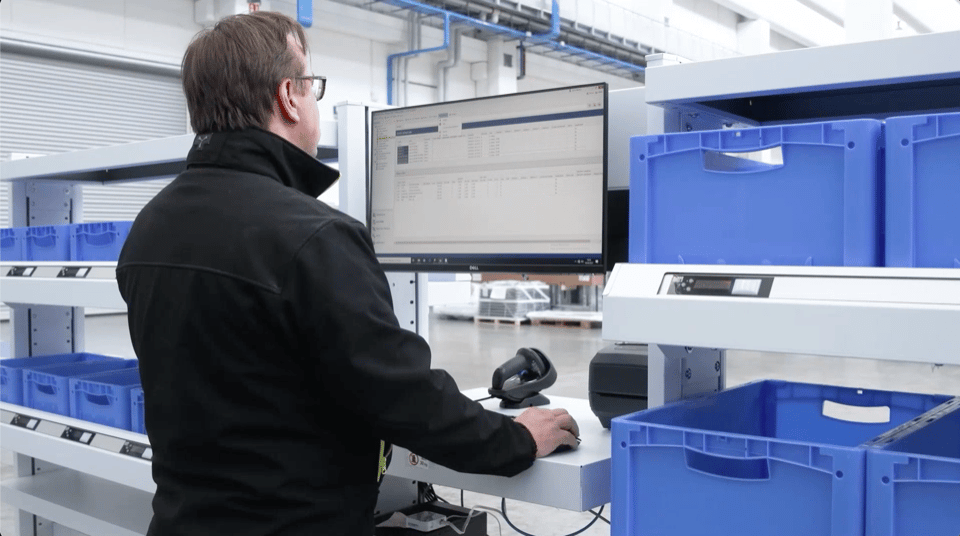
Stay updated on your inventory levels.
Warehouse Management System (WMS) Explained
A warehouse management system is software designed to help businesses manage and optimize warehouse operations.
It provides real-time visibility into inventory, supports receiving and storage activities, and helps streamline picking, packing and shipping workflows.
Many WMS platforms also integrate with ERP systems, transportation platforms, barcode technologies and warehouse automation solutions to improve accuracy and operational efficiency.
Types of Warehouse Management Systems (WMS)
Warehouse management systems vary in structure and capability, with each type designed to support different levels of operational complexity, integration, and scalability.
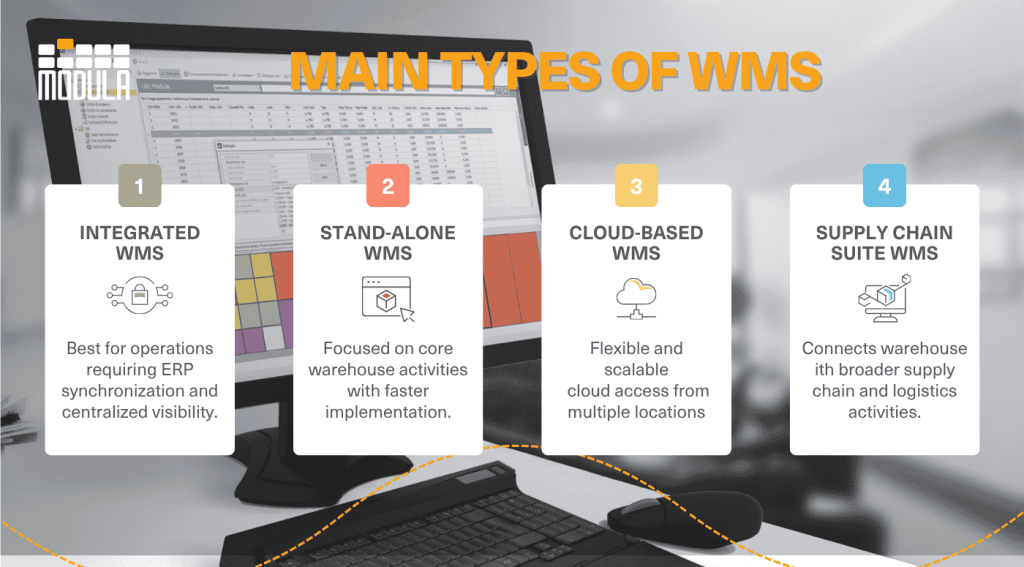
The most common types of warehouse management systems include:
Integrated Warehouse Management System
If your warehouse operations are tightly connected to broader business functions, such as order fulfillment, inventory planning and financial reporting, an integrated WMS is often the most strategic choice.
This type of WMS functions as an extension of your enterprise resource planning (ERP) system.
Since ERP platforms already centralize core processes like finance, customer relationship management, and project tracking, the WMS naturally fits into that ecosystem.
What makes this setup particularly effective is its ability to keep everything connected. Inventory data, sales orders, and financial records stay synchronized, giving businesses a unified, immediate view of operations.
Stand-Alone WMS
A stand-alone WMS focuses strictly on warehouse operations. It handles core functions such as inventory tracking, stock control, and reporting without relying on other enterprise systems.
Because of its narrower scope, this type of warehouse management system is typically more affordable and faster to deploy.
However, businesses may require additional systems to manage functions such as accounting, transportation or advanced order processing.
Some stand-alone WMS platforms are deployed on-premise, while others are available as cloud-based solutions.
Cloud-Based WMS
If your company needs flexibility and quick deployment, a cloud-based WMS is often the go-to option.
Instead of relying on locally installed infrastructure, this type of warehouse management system is hosted remotely and accessed via the internet.
This means teams can manage operations from virtually anywhere, which is especially useful for multi-site warehouses or distributed supply chains. It also cuts down the need for in-house infrastructure and IT support.
Cloud-based systems are typically easier to scale as operations grow; software updates are handled by the provider, and most platforms can be easily configured to match your workflows, dashboards, and integration needs.
Many modern WMS platforms can also integrate with connected technologies and IoT-enabled solutions, such as Modula IoT, to provide additional monitoring, analytics and operational visibility.
Typically offered on a subscription basis, cloud solutions lower upfront costs while simplifying long-term system management.
Supply Chain Suite WMS
A supply chain suite WMS is part of a broader supply chain management (SCM) platform that connects warehouse operations with other supply chain functions.
In addition to warehouse management, these systems may support transportation management, procurement, manufacturing coordination, demand planning and partner collaboration.
This broader visibility helps businesses coordinate activities across multiple facilities and supply chain stages in real time.
For instance, third-party logistics (3PL) providers often rely on this type of system to better align warehouse operations with transportation schedules and shifting customer demand.
While it typically requires more complex integration upfront, the result is a more synchronized and efficient end-to-end supply chain.
Benefits of a Warehouse Management System (WMS)
At its core, a WMS helps cut inefficiencies and keeps things running smoothly as your order volume picks up.
Here are a few ways it can improve your day-to-day operations:
Optimized Space and Lower Operating Expenses
A warehouse management system improves space utilization by analyzing workflows, product characteristics, and storage needs.
It helps reduce wasted floor space and unnecessary movement, cutting down time spent locating, placing and retrieving inventory.
This kind of optimization has a direct impact on costs by reducing excessive material handling and improving overall efficiency and productivity across warehouse activities.
WMS solutions can also support inventory rotation methods such as FIFO, FEFO, and LIFO, depending on operational requirements.
FIFO and FEFO are commonly used in industries where product freshness, traceability, or expiration management are critical, while LIFO may be used in environments focused on storage density and handling efficiency.
More advanced systems apply flexible logic, allowing similar items, such as those with close expiration dates, to be picked together.
Strengthening Inventory Security
Without the right controls in place, warehouses remain vulnerable to inventory discrepancies caused by theft, misplacement, manual errors, and unauthorized access. This happens even in highly automated facilities.
In fact, even major operations have faced internal theft issues, with former Amazon workers accused of stealing more than $25,000 in merchandise.
A warehouse management system adds a critical layer of security by enforcing role-based access controls, user permissions, and detailed activity tracking. This allows businesses to control who accesses specific inventory and maintain a clear audit trail of every transaction.
Beyond theft prevention, this level of visibility helps quickly identify discrepancies, minimize internal errors, and ensure accountability across your workforce.
Enabling Faster Shipping
Gone are the days when next-day shipping set the standard. With companies like Amazon rolling out one-hour and three-hour delivery, speed is now a competitive expectation.
A well-optimized WMS helps you move orders out the door faster by turning live data into actionable decisions.
Instead of relying on assumptions, your team can see exactly:
- Where inventory is located
- How quickly are orders being processed
- What capacity is available across order picking, packing and shipping
This makes it easier to determine whether faster delivery options, like same-day or overnight shipping, can be supported without disrupting operations.
For instance, a WMS can surface the most efficient fulfillment paths based on where inventory is stored and how orders are flowing through the warehouse.
This allows you to move faster when conditions allow, without compromising accuracy or putting unnecessary strain on operations.
Improved Traceability and Compliance
Modern warehouse management systems do more than track inventory quantities. They also help businesses maintain accurate traceability across warehouse operations.
Advanced WMS platforms can track:
- Lot and batch numbers
- Serial numbers
- Expiration dates
- Material movements
- User activity and transaction history
This level of visibility is especially important in industries such as pharmaceutical, food and beverage, automotive, aerospace and medical manufacturing, where inventory accuracy and compliance requirements are critical.
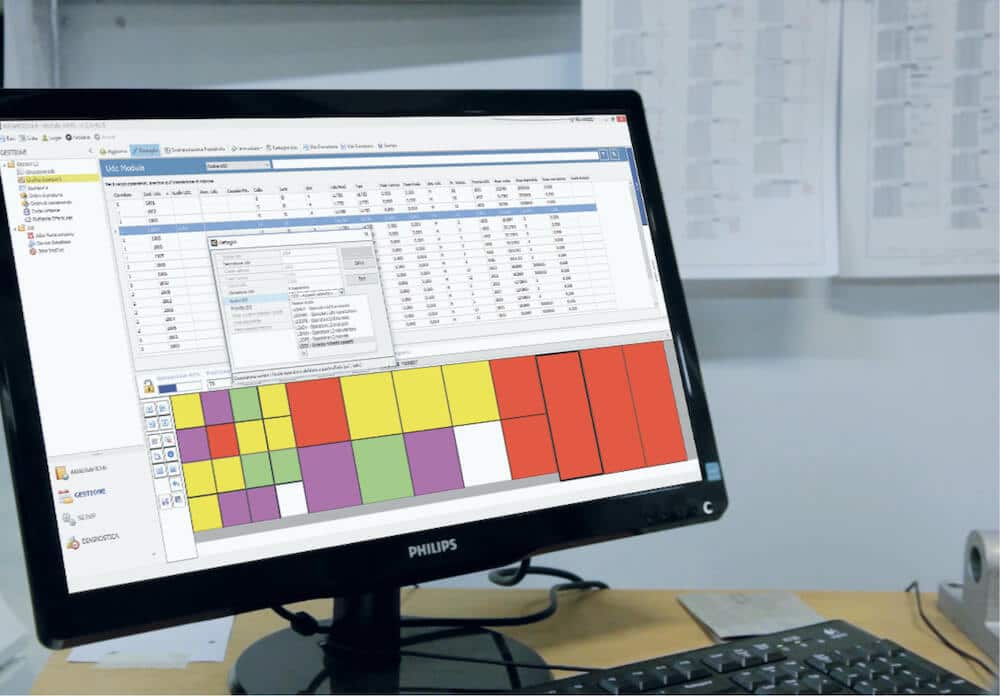
Warehouse Management System (WMS) vs. Other Warehouse and Inventory Systems
There’s no shortage of warehouse software solutions out there; each focused on a specific function, whether it’s inventory tracking, order management, fulfillment or shipping.
Let’s take a look at the most widely used warehouse systems and where each one fits in.
| System | Primary Function | Key Focus | Typical Use Case |
|---|---|---|---|
| WMS (Warehouse Management System) | Oversees complete warehouse operations | Real time inventory visibility, storage optimization, picking, packing and shipping | Improving overall warehouse performance and fulfillment efficiency |
| WCS (Warehouse Control System) | Manages and directs warehouse equipment | Coordination of conveyors, sorters and automated systems | Controlling material flow between automated equipment |
| WES (Warehouse Execution System) | Coordinates workflows between software, labor and automation systems | Real-time coordination of labor and automation | Improving synchronization between people, equipment and automated systems |
| OMS (Order Management System) | Handles the entire order lifecycle | Order processing, tracking, and fulfillment accuracy | Managing customer orders from placement through delivery |
| TMS (Transportation Management System) | Oversees transportation and logistics activities | Route optimization, carrier selection, and shipment planning | Streamlining the physical movement of goods across the supply chain |
| IMS (Inventory Management System) | Monitors and controls inventory levels | Stock tracking, inventory replenishment, and inventory analysis | Maintaining accurate inventory across locations and sales channels |

Examples of Top Warehouse Management Systems
Here’s a look at some of the most widely used warehouse management systems and what they bring to modern warehouse operations.
- Modula WMS: a warehouse management system developed by Modula to support inventory management, order fulfillment and warehouse optimization in both traditional and automated storage environments. It provides real-time inventory visibility, traceability, and integration with Modula automated storage systems and other warehouse technologies.
- SAP EWM: An enterprise-level solution designed for real-time inventory management and end-to-end supply chain visibility.
- Oracle NetSuite WMS: A cloud-based platform known for its flexibility, particularly for managing inventory across multiple locations.
WMS and Warehouse Automation
Modern warehouse management systems can also integrate with warehouse automation technologies to improve efficiency, accuracy, and throughput.
Depending on the operation, a WMS may connect with:
- Automated storage and retrieval systems (ASRS)
- Vertical lift modules (VLMs)
- Barcode scanning systems
- Pick-to-light solutions
- Mobile picking applications
- Autonomous mobile robots (AMRs)
These integrations help synchronize inventory movements, reduce manual tasks and improve visibility across warehouse operations.
How To Choose the Best WMS for Your Business
With so many WMS options available, it’s not always clear what to prioritize.
Understanding the different types of warehouse management systems is a good starting point, but the right choice ultimately depends on how well the solution fits your specific operations.
Here are some business-specific considerations to evaluate as you compare different WMS solutions:
Every warehouse operates differently, so your business model, industry, and growth plans will influence which type of warehouse management system makes the most sense for your operations.
-

Industry-specific needs: Start by identifying the features that matter most for your industry. For example, an apparel brand may need support for high SKU volumes and seasonal demand spikes, while a food or beverage company will likely require lot tracking and expiration date management.
-

SKU count: Consider how many SKUs you manage on a regular basis. Some systems are built to handle large, complex inventories, while others are better suited for smaller operations.
-

Customization capabilities: Look at how flexible the system is. Can it support custom packaging, kitting and bundling? Does it allow you to set rules or logic to customize orders based on specific criteria?
-

Scalability: As your business grows, your WMS should grow with it. Whether you’re adding new SKUs, expanding into new regions or increasing order volume, the system should be able to support that growth without requiring a full overhaul.
At Modula, we provide advanced warehouse management systems and automated storage solutions designed to improve space utilization, streamline picking operations, and enhance inventory control across a wide range of industries.
Our WMS is built as a flexible, end-to-end platform. It can operate independently in manual warehouse environments or integrate seamlessly with automated storage and retrieval systems (ASRS), depending on your setup.
It’s built for day-to-day warehouse use, with a clean interface that makes it easy for teams to manage tasks without slowing down operations.
It also integrates seamlessly with most ERP and DMS platforms, helping ensure faster and more accurate processes across receiving, storage and order fulfillment.
If you’re ready to make your warehouse more efficient, we’re here to help. Let’s talk about what type of warehouse management system (WMS) would work best for your operation.
Run a more efficient warehouse.
Types of Warehouse Management Systems: Key Takeaways
- Different types of warehouse management systems serve different needs: From stand-alone to integrated and cloud-based systems, each supports varying levels of complexity, scalability and integration.
- A WMS drives operational efficiency: It optimizes space, reduces movement and improves inventory control, helping lower costs and increase accuracy.
- The right type of WMS depends on your operations: Industry needs, SKU volume, customization and scalability all influence the best fit for long-term performance.
Types of Warehouse Management Systems: FAQs
What are the main types of warehouse management systems?
The most common types of warehouse management systems include integrated, stand-alone, cloud-based and supply chain suite WMS.
Can different types of warehouse management systems work together?
Yes, many warehouse systems can work together when properly integrated.
For example, a WMS can connect with ERP, TMS, or OMS platforms to streamline operations, improve data flow, and provide better visibility across the supply chain.
How long does it take to implement a warehouse management system?
Implementation timelines can vary depending on the complexity of your operations and the type of WMS you choose.
Cloud-based systems can often be deployed in a few weeks, while more advanced or highly integrated solutions might take several months to fully implement and optimize.
What is the difference between a cloud-based and on-premise WMS?
A cloud-based WMS is hosted remotely and accessed through the internet, typically offering faster deployment, easier scalability and reduced IT infrastructure requirements.
An on-premise WMS is installed locally on a company’s own servers and infrastructure, providing greater internal control over system management and data storage.
The right choice depends on operational requirements, IT resources and long-term business goals.
Can a WMS manage both manual and automated storage areas?
Yes. Many warehouse management systems can manage both manual and automated warehouse environments from a centralized platform.
This helps businesses maintain consistent inventory control, traceability and operational visibility across different storage areas and workflows.