Just-in-Time Inventory Management for Modern Warehouses
In the supply chain, efficiency is everything. When orders are pouring in and products need to ship quickly, keeping accurate track of what’s in stock—and what’s not—becomes increasingly difficult.
For the past few years, many companies adopted a “just-in-case” approach, stockpiling materials to survive supply chain disruptions. But that safety net has become a massive financial burden.
According to the latest research by IHL Group, global inventory distortion, the combined cost of out-of-stocks and overstocks, now costs businesses an astonishing $1.7 trillion annually.
Furthermore, the inventory carrying costs for warehousing, insuring, and managing this surplus stock eat up anywhere from 20% to 30% of a company’s total inventory value each year.
Holding excess inventory is no longer a sustainable strategy. Warehouse managers are once again being asked to do more with less: less space, less tied-up capital, and less wast.
That’s where a return to smart just-in-time inventory management comes in.
In this guide, we will:
- Explain what just-in-time inventory management really is
- Share how just-in-time inventory management works in operational terms
- Cover the benefits and limitations to consider
- Discover why technology often plays a key role in making just-in-time inventory management strategies sustainable in modern warehouses.
A Closer Look at Just-in-Time Inventory Management
But what is just-in-time inventory, exactly?
At its core, Just-in-Time (JIT) inventory is a strategy where materials are purchased, received, and produced only as they are needed in the production process or for fulfillment.
Instead of stocking up on goods months in advance, a just-in-time inventory management strategy ensures that parts arrive on the dock exactly when they are required, hours or days before they are used, minimizing the need for massive storage space.
To understand this inventory management, it’s essential to grasp the difference between “Push” and “Pull” systems.
Traditional warehousing relies on a push approach, producing goods based on forecasts and pushing them into storage.
Just-in-time inventory management follows a pull model, where production and inventory replenishment are triggered by actual demand.
Initially introduced by Toyota through its Production System (TPS), this inventory strategy aims to eliminate waste (muda) by keeping inventory levels as low as possible.
In an ideal JIT setup, raw materials arrive and go straight into production, without sitting idle on a shelf.

How JIT Inventory Management Works
Just in time inventory management works on a pull-based system; that means nothing gets produced or replenished until there’s an actual need for it.
Instead of relying solely on forecasts, just in time inventory management responds to real-time demand.
That might be a customer placing an order, a production step being completed, or even a picking confirmation in the warehouse, all of which can trigger upstream replenishment.
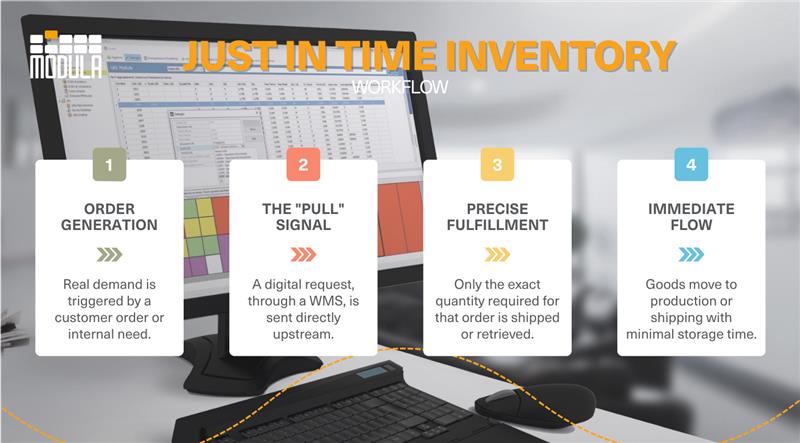
A typical just in time inventory management workflow includes:
- Order Generation: A customer places an order, or a downstream internal process signals a need (for example, an assembly station runs low on parts).
- The “Pull” Signal: This triggers a digital request, often via a WMS. The request is sent upstream to the supplier or the warehouse receiving area.
- Precise Fulfillment: The supplier ships or the warehouse retrieves only the exact quantity needed for that specific batch.
- Immediate Flow: Goods arrive at the receiving dock and are routed directly to production or shipping, minimizing or eliminating dwell time in storage.
Just-in-Time (JIT) vs. Just-in-Case (JIC) Inventory Management: Key Differences
The inventory conversation usually boils down to just-in-time (JIT) vs. just-in-case (JIC).
Just-in-case focuses on having extra stock as a safety net, while just-in-time inventory management is all about cutting excess and dialing in precision to drive financial efficiency.
- Just-in-time inventory systems: You order inventory only when sales are confirmed. You hold minimal stock, which frees up cash flow and floor space.
- Just-in-case inventory systems: You keep large amounts of “safety stock” to protect against supply chain disruptions or sudden spikes in demand.
While JIC offers a buffer, it comes with high inventory carrying costs. A just-in-time inventory management strategy removes those costs but requires a precise, agile operation to avoid stockouts.
| Feature | Traditional (Just-in-Case) | Just-in-Time (JIT) |
|---|---|---|
| Inventory Levels | High (Large Safety Stock) | Minimal (Near Zero) |
| Capital Tied Up | Significant (Cash is stuck on shelves) | Low (Cash flows freely) |
| Space Usage | High footprint required | Optimized / Minimal footprint |
| Risk Profile | Low risk of stockout, high risk of obsolescence | High risk of stockout, low risk of obsolescence |
| Process Speed | Slower (Hampered by congestion) | Fast (High turnover) |
| Error Tolerance | High (Safety stock covers mistakes) | Zero (Errors stop production) |
Modern logistics is shifting toward a hybrid model, but if you want to stay competitive on both cost and speed, leaning into a just in time inventory management system is crucial.
The real challenge is managing the risk, and that’s where visibility and automation make all the difference.

Dynamic Buffer Storage vs. Safety Stock: Why the Difference Matters in JIT Inventory Management Systems
A common misconception is that just-in-time inventory management means “zero inventory.” In practice, effective JIT inventory management depends on buffer storage (not to be confused with safety stock).
Safety stock is inventory held “just-in-case” of external disruptions like supplier delays, transportation issues, or unexpected demand spikes.
While it can be useful, it goes against the core goal of just-in-time inventory management: minimizing excess inventory and exposing inefficiencies instead of masking them.
Buffer storage, on the other hand, is about managing internal flow variability.In day-to-day operations, processes rarely sync perfectly; one station might run faster than the next or experience brief micro-stoppages.
Without a buffer, even small interruptions can cascade and stall downstream activity.
A controlled buffer acts as a temporary, limited cushion, absorbing these fluctuations without reverting to excess inventory. When managed well, it supports the flow without undermining JIT inventory systems.
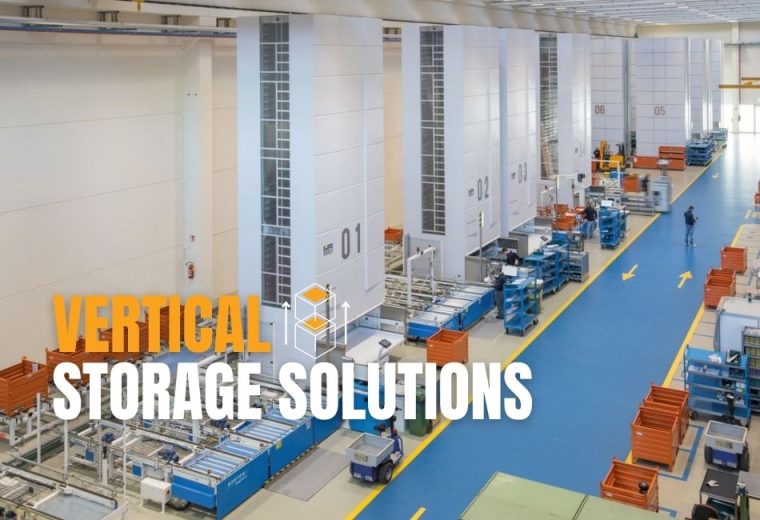
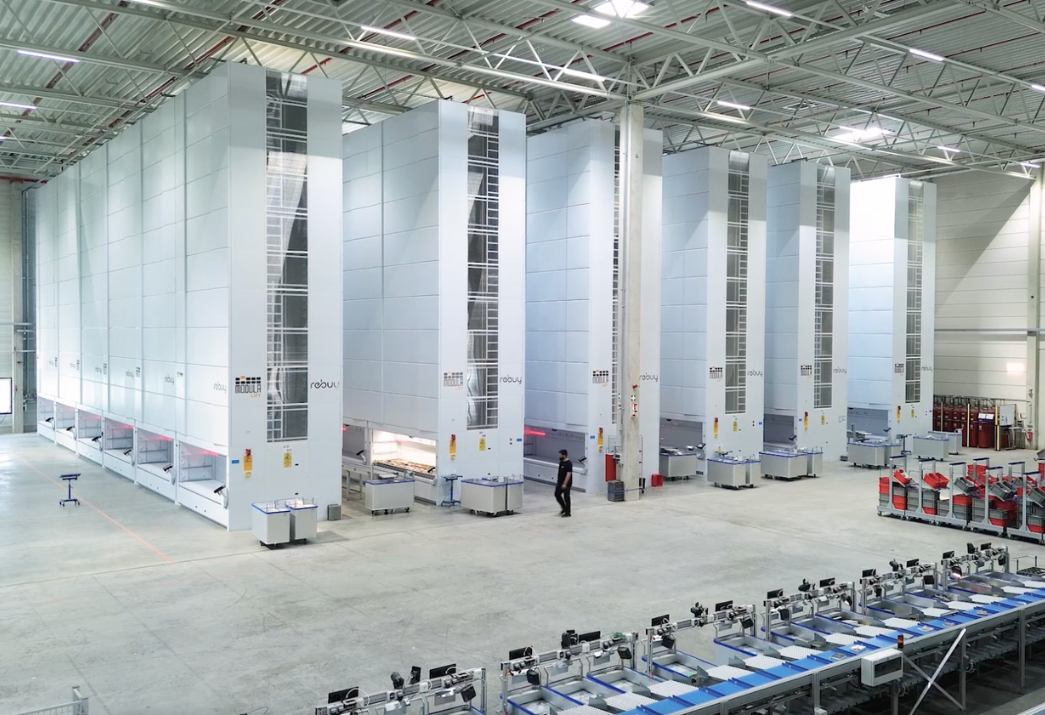
Automation makes this even more effective. Systems like vertical lift modules (VLMs) can serve as active WIP buffers, storing temporary inventory vertically. This not only clears floor space but also reduces handling risks and improves visibility and control.
Well-managed buffer storage doesn’t weaken just-in-time inventory management. In fact, it strengthens it, helping teams operate more efficiently and adapt to the demands of modern fulfillment.
Implementing Just-in-Time Inventory Management: Key Operational Steps
Shifting to a just-in-time inventory approach doesn’t happen overnight.
It’s usually a gradual, structured process. Instead of cutting inventory levels all at once, companies work through a series of operational changes:
- Building up reliability
- Improving visibility
- Boosting responsiveness along the way
Here’s how most operations make the transition:
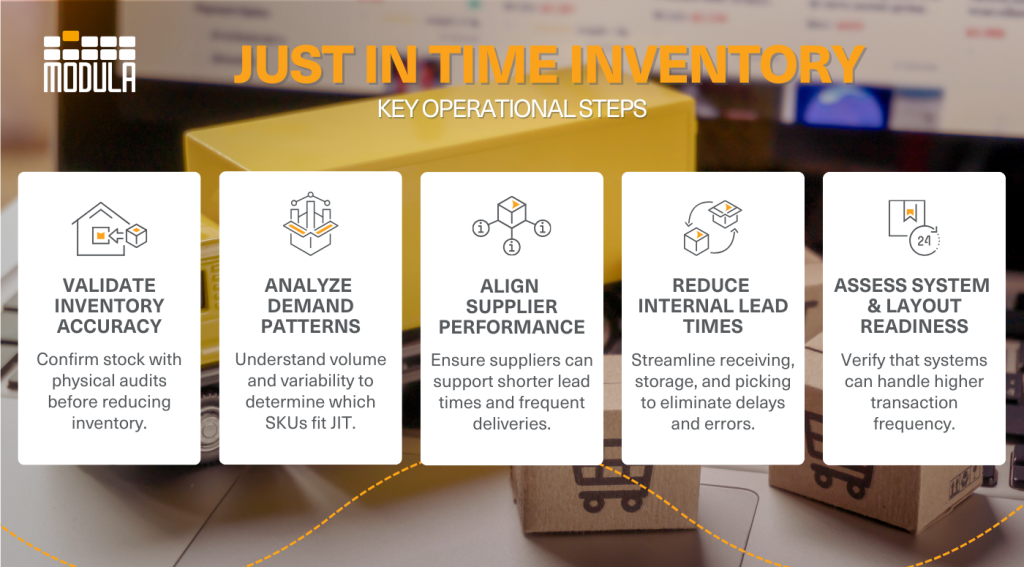
- Validate inventory data through physical audits: Before reducing stock levels, it is essential to verify your inventory accuracy. Without a reliable inventory baseline, just in time inventory management increases the risk of stockouts and operational disruptions.
- Analyze demand patterns and variability: Just-in-time inventory management relies on a clear understanding of demand behavior. High-volume or predictable SKUs are often addressed first, while highly volatile or low-rotation items may require different inventory strategies.
- Align suppliers around smaller, more frequent deliveries: Supplier collaboration is essential. Just-in-time inventory management requires shorter lead times and more frequent replenishment cycles, which often means renegotiating delivery schedules and service-level expectations.
- Reduce internal lead times and handling inefficiencies: Internal processes must be examined as closely as external ones. Time spent receiving, storing, locating, and transporting items within the warehouse directly affects the performance of a just-in-time inventory system. Reducing unnecessary movement, streamlining picking paths, and minimizing search time helps ensure materials are available when needed without delay.
- Evaluate whether existing systems and layouts can support higher transaction frequency: Just-in-time inventory management increases inventory movements and system transactions, even when total volume stays the same. Warehouses need to assess whether their layouts, storage methods, and management systems can support this faster pace while maintaining accuracy and visibility.
Benefits of Just-in-Time Inventory Management
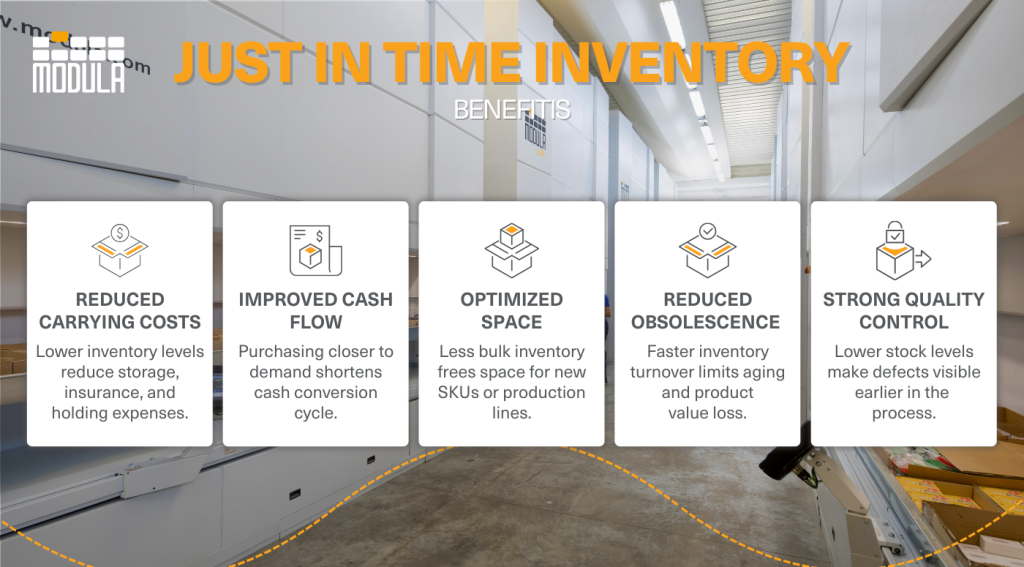
Why are companies adopting the just-in-time inventory model? The ROI is measurable in three key areas:
- Reduced carrying costs: Inventory holding costs aren’t cheap. Between warehousing, HVAC, insurance, depreciation, and security, it usually costs 20 to 30% of the inventory value every year. Just-in-time inventory management cuts that expense almost immediately.
- Cash flow liquidity: When you only buy goods after a sale is confirmed, you shorten the cash conversion cycle. You’re not tying up cash by paying suppliers months before your customers pay you.
- Optimized warehouse density: By reducing bulk inventory, you reclaim valuable square footage. This allows you to expand production lines or introduce new SKUs without leasing a new building.
- Obsolescence protection: In industries like electronics, fashion, and automotive, products age quickly. If inventory sits for six months, it’s often already lost value. Just-in-time inventory management can help ensure goods are used or sold while they’re still current and in demand.
- Quality control: When you’re working with lower stock levels, defective items get spotted right away, either when they arrive or when they’re used, rather than turning up months later at the bottom of a bin.
Risks and Limitations of the Just-in-Time Inventory Systems
Just-in-time inventory management isn’t without its hurdles, so it’s important to take a clear look at the risks before scaling back your buffers.
- Greater exposure to supply chain disruptions: With limited safety stock, delays from suppliers, transportation issues, or quality problems can have an immediate impact on operations.
- Higher sensitivity to internal execution errors: In a JIT environment, picking mistakes or misplaced items become more visible and more disruptive. Lean inventory levels leave less margin to correct errors after the fact, increasing the importance of standardized processes and operator accuracy.
- Increased handling and coordination requirements: JIT typically relies on smaller, more frequent deliveries. If receiving and putaway processes are not well organized, the operational cost of handling these shipments can offset some of the inventory savings.
- Strong dependency on data accuracy and inventory visibility: JIT inventory management places higher demands on inventory accuracy and system reliability. Even small discrepancies between physical stock and system records can result in stockouts, missed picks, or delayed orders,
- Need for process and organizational maturity: Successful JIT implementation depends on disciplined execution, reliable suppliers, and well-aligned systems. Without this foundation, JIT risks becoming a cost-cutting exercise that exposes weaknesses rather than a sustainable inventory strategy.
For these reasons, JIT should be viewed as a strategy that requires maturity in processes, systems, and supplier relationships rather than a standalone cost-cutting initiative.
The Limits of Manual Warehousing in a JIT Inventory System
As order volumes grow and batch sizes shrink, manual warehousing hits practical limits.
High walking distances, search time, and manual checks become more costly when large, infrequent picks shift to frequent, smaller ones.
Under a just-in-time inventory management approach, where buffers are minimal, maintaining speed and accuracy becomes even more difficult, prompting many companies to explore process redesign or automation to stay on pace.
How Automation Strengthens a JIT Inventory System
As inventory buffers are reduced, the margin for operational variability also narrows. For this reason, many companies supporting just-in-time inventory control rely on automation to stabilize execution at the warehouse level.
Automated storage and retrieval systems (AS/RS), including vertical lift modules (VLMs) and horizontal carousels, are commonly used to support JIT inventory control by improving inventory visibility, execution speed, and operational consistency.
Here is how specific Modula solutions support the JIT workflow:
Real-Time Synchronization With Warehouse and Business Systems
Just-in-time inventory control depends on timely and accurate demand signals. When materials are consumed or orders are released, those signals must translate quickly into warehouse actions.
Modula’s warehouse management system (WMS) is designed to integrate with your existing ERP, enabling real-time inventory visibility and full traceability, both critical for effective JIT inventory control.
When a production order is released, the WMS translates that signal into a retrieval task.
This reduces the latency between the “pull signal” and the warehouse action, ensuring that inventory data is updated in real-time across the organization.
Consistent Speed in High-Frequency Picking
Just-in-time inventory management increases the frequency of warehouse transactions, even when overall inventory volumes decline. Orders and replenishment tasks are typically smaller, but they occur more often.
Instead of massive weekly batches, operations may require frequent, smaller picks throughout the day. Modula Lift VLMs are built to handle this type of workflow efficiently.
By delivering items directly to the operator (“Goods-to-Person“), they minimize walking time, making it easier to maintain consistent picking performance throughout the day. This is essential since delays in warehouse execution can quickly affect downstream operations.
Improved Accuracy and Inventory Reliability
When safety stock is limited, inventory errors have immediate consequences. Incorrect picks, misplaced items, or quantity discrepancies can interrupt production or delay shipments.
Automation supports higher accuracy by guiding operators to the correct item and quantity and by recording each transaction digitally.
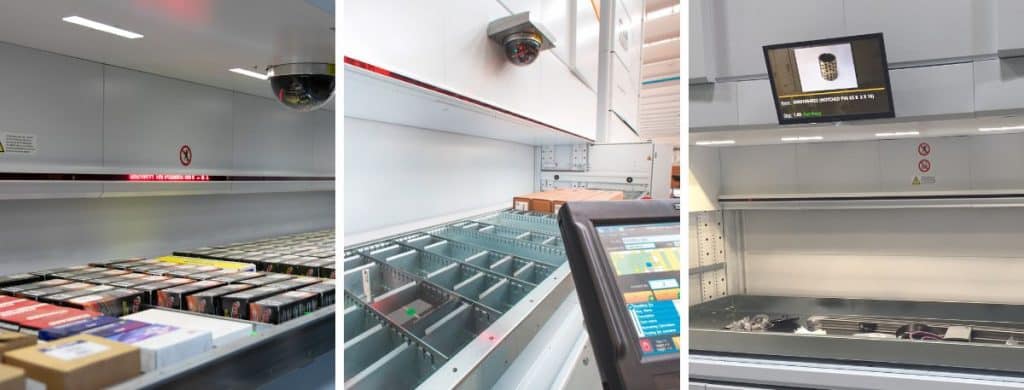
Modula units utilize visual picking aids (such as laser pointers and alphanumeric bars) to guide operators to the correct item and quantity.
This technology significantly reduces the risk of human error, providing the inventory reliability needed to operate confidently with lower stock levels.
Secure Access and Controlled Operations
In JIT environments, inventory accuracy is not only a matter of speed, but also of control. Modula systems track user logins and monitor all picking and replenishment operations at the tray level.
This helps prevent duplicate picks, unauthorized access, and loss of high-value items, while reducing the administrative burden associated with correcting inventory discrepancies, investigating errors, or managing shrinkage.
Space Efficiency and Adaptable Storage Configuration
JIT strategies often require inventory to be stored close to where it is used, while occupying as little floor space as possible.
Modula VLMs store a large number of items in a compact vertical footprint, bringing materials closer to production or fulfillment areas and shortening internal travel distances.
Their modular design allows storage height to be adjusted over time, adapting to changes in facility layout or ceiling height.
Trays can be configured with partitions and dividers to match the exact size and quantity of stored items, and layouts can be reconfigured as products, tools, or SKUs change.
This flexibility helps maintain consistent output even as inventory profiles evolve.
When a JIT Inventory System Makes Sense for Your Operation
A just-in-time inventory management strategy is ideal for:
- High-Value items: Where holding costs are prohibitive.
- High Turnover SKUs: Fast-moving goods where demand is predictable.
- Space-Constrained Facilities: When expanding the warehouse is not an option.
- Manufacturing Assembly: Where parts are needed in a specific sequence (Just-in-Sequence).
When a JIT Inventory System Isn’t the Best Option
On the flip side, pure JIT doesn’t always fit well with:
- Highly Volatile Demand: If orders spike unpredictably by 500%, JIT cannot react fast enough.
- Long Lead-Time Suppliers: If materials take three months to arrive from overseas, you need safety stock (JIC).
- Low-Value Consumables: It is rarely worth optimizing the flow of cheap hardware like standard washers or nuts; the risk of running out outweighs the savings.
Just-in-Time (JIT) Inventory Management: Key Takeaways
- Just-in-time inventory management is a strategy, not a formula: JIT works best when backed by reliable processes, accurate data, and well-coordinated suppliers. Without that foundation, it’s more likely to expose operational gaps than improve efficiency.
- Reducing inventory is the result of better flow, not the starting point: Successful just-in-time inventory management focuses on synchronizing material flow with demand. Lower stock levels follow naturally when processes are aligned and predictable.
- Buffer storage is not the same as safety stock: While just-in-time inventory management aims to eliminate excess safety stock held for external uncertainty, controlled buffer storage plays an important role in managing internal variability and maintaining flow.
- Technology often determines whether just-in-time inventory management is sustainable at scale: As transaction frequency increases and inventory buffers shrink, visibility, speed, and accuracy become critical. Automation helps stabilize execution under these conditions.
- Just-in-time inventory management works best as part of a balanced, long-term approach: For many organizations, it’s not an end state but one component of an ongoing effort to balance efficiency, resilience, and growth.
Frequently Asked Questions (FAQ) about Just-in-Time Inventory Management
What is just-in-time inventory?
At its core, just-in-time inventory management is about receiving materials and producing goods only as they’re needed.
Instead of stockpiling inventory months in advance, this strategy ensures parts arrive just hours or days before use, reducing storage needs and keeping operations lean.
What is the main risk of just-in-time inventory management?
The primary risk is supply chain disruption. Since JIT minimizes safety stock, a delay from a supplier or a transportation issue can quickly impact production. Success requires reliable suppliers and precise internal planning.
Does JIT mean zero inventory?
No, this is a common misconception. JIT aims for optimized inventory. The goal is to hold the minimum amount necessary to maintain a smooth flow (buffer stock), rather than holding excess stock “just in case.”
Do I need automation to run JIT?
Not necessarily, but it helps. JIT increases the number of transactions (picking and replenishment). While manual operations can handle this at lower volumes, automation becomes a key enabler for maintaining speed and accuracy as operations scale.
Can small businesses benefit from JIT?
Yes. While often associated with large manufacturers, JIT principles help businesses of all sizes improve cash flow. For SMBs, reducing holding costs and freeing up capital is often just as critical as it is for large enterprises.