Automation in Production: How To Drive Efficiency in 2026
With U.S. households spending about $77,280 annually on average, manufacturers are under constant pressure to produce more, faster.
To meet that demand while controlling costs and improving inventory visibility, many are turning to warehouse automation.
What was once a competitive advantage is quickly becoming a necessity, as automation helps manufacturers improve productivity, lower costs, and match the pace of market demand.
In this article, we will:
- Share the types of automation in production
- Cover the operational benefits of automation
- Discover how Modula helps manufacturers operate more efficiently while supporting smarter warehouse management

Automation in Production Explained
Automation in production, or automation in manufacturing, is the process of utilizing technology to optimize and manage the process of turning raw materials, components, and parts into finished products.
Automated solutions include equipment, such as warehouse management systems, robotics, and automated storage and retrieval systems.
These solutions allow you to automate tasks and processes, boost efficiency, improve inventory visibility, and cut operational costs, among other benefits.
Types of Automation in Production
Manufacturers can implement automation in different ways, depending on their products, processes, and production volumes.
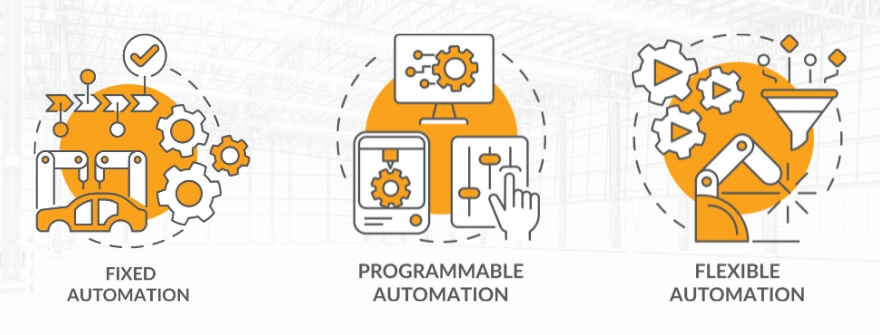
The three main categories of automation in production include:
1. Fixed Automation
Fixed automation involves the use of specialized machinery and equipment that is designed to perform specific tasks in a production process.
It is called “fixed” because the machinery and equipment are fixed in place and cannot be easily adapted to perform different tasks.
The equipment used in fixed automation is designed for the high-volume production of identical products, where the manufacturing process is precisely controlled and repetitive.
Typically, fixed automation is used in mass production settings, such as in the automotive or electronics industries. Examples of fixed automation include conveyor belts, ASRS, and palletizers.
2. Programmable Automation
Programmable automation refers to the machinery and equipment that can be programmed to perform a variety of tasks in the production process.
Unlike fixed automation, programmable automation is designed to be flexible and adapt to changing production requirements.
Examples of programmable automation include robotic arms, collaborative robots, and mobile robots.
3. Flexible Automation
Flexible automation is used in applications where the production process often undergoes rapid changes and is highly variable.
This type of automation allows manufacturers to quickly adapt to evolving market demands, product design changes, and other factors that affect production.
Examples of flexible automation include multi-purpose robotic and modular conveyor systems, which can be easily reconfigured to handle diverse or unique products.

5 Benefits of Automation in Manufacturing
From cutting warehouse costs to preventing overstock, here are five ways that automation in production can benefit your warehouse operations.
Lower Costs
Automation can help businesses do more with less. It minimizes the time spent on repetitive tasks, improves accuracy, and boosts productivity, all while making better use of warehouse space and resources.
With Modula solutions, the typical ROI period from a vertical lift module (VLM) or horizontal carousel (HC) ranges from just 6 to 18 months, making top-quality automated solutions an undoubtedly worthwhile investment.
Increased Workplace Safety
According to recent workplace safety data, overexertion and repetitive motion accounted for the highest number of Days Away from Work, Job Restriction, or Transfer (DART) cases.
Automated storage and retrieval systems help address these challenges by bringing items directly to operators, reducing physical strain, and limiting unnecessary movement throughout the facility.
Improved Efficiency
The warehouse robotics market continues to grow as manufacturers look for ways to improve efficiency and maintain quality.
By automating repetitive tasks, businesses can cut down on errors, make better use of resources, and free employees to focus on higher-value work.
In the warehouse, automation can assist with transporting, locating and picking inventory, helping operators work faster, improve accuracy, and boost overall productivity.
Greater Productivity
There are a lot of moving parts in the production process, many of which are time-consuming and prone to human error.
Automated solutions allow your warehouse operators to focus on the areas where they’re needed most, and leave the repetitive, mundane or even dangerous tasks to machines. In turn, productivity skyrockets.
Better Inventory Control and Visibility
Maintaining complete visibility over your inventory means having an up-to-date understanding of the quantity and location of your raw materials, finished products, and work-in-progress items at all times.
This allows you to make informed decisions about production schedules, resource allocation, and inventory management, ensuring that your manufacturing processes run smoothly
Warehouse management systems give you full visibility and control of your inventory. You can prevent overstocking and stock shortages, minimize waste and downtime, and respond quickly to changing market conditions or production disruptions.

Explore Modula Solutions for Smarter Manufacturing Operations
From vertical storage solutions that keep your inventory safe to a warehouse management system that gives you complete inventory visibility, Modula’s automated solutions help reimagine your manufacturing process.
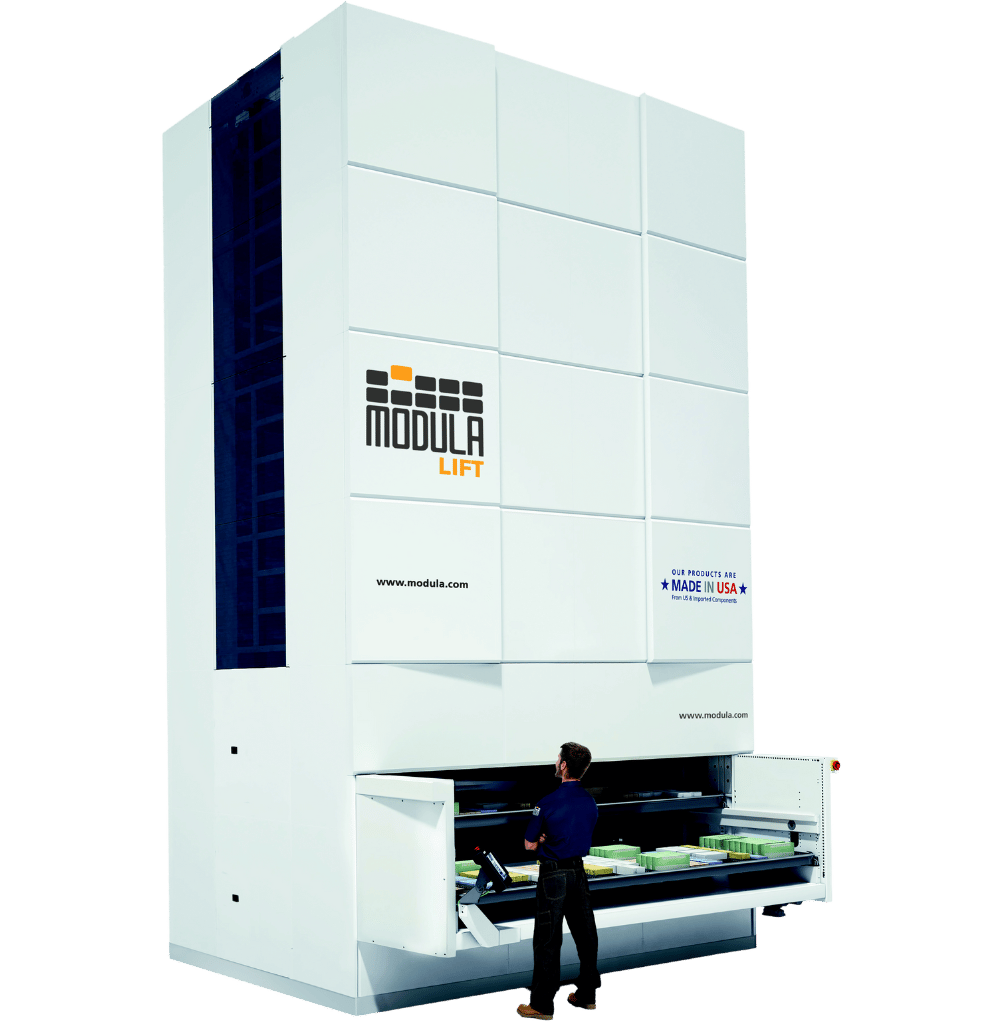
1. Modula Vertical Lift Modules
Vertical lift modules (VLMs) help manufacturers maximize storage capacity while freeing up valuable floor space for production and other operations.
Designed with safety and ergonomics in mind, VLMs deliver items directly to operators, lowering the need for excessive reaching, bending and walking throughout the facility.
VLMs can be customized to support a wide range of storage requirements, from parts and tools to raw materials. They also integrate with warehouse inventory management systems, providing real-time stock visibility, and simplifying inventory replenishment.
By combining high-density storage with automation, VLMs help improve productivity and minimize warehouse costs.

Modula vertical lift modules come in five models:
Modula vertical lift modules:
- Are quick to install and easy to use
- Save up to 90% of floor space compared to the traditional storage system
- Process complex orders in less time, even during peak seasons
- Protect your inventory thanks to locking and validation features
- Monitor employee log-ins and track picking operations, depending on the selected level of security
- Offer a scalable design
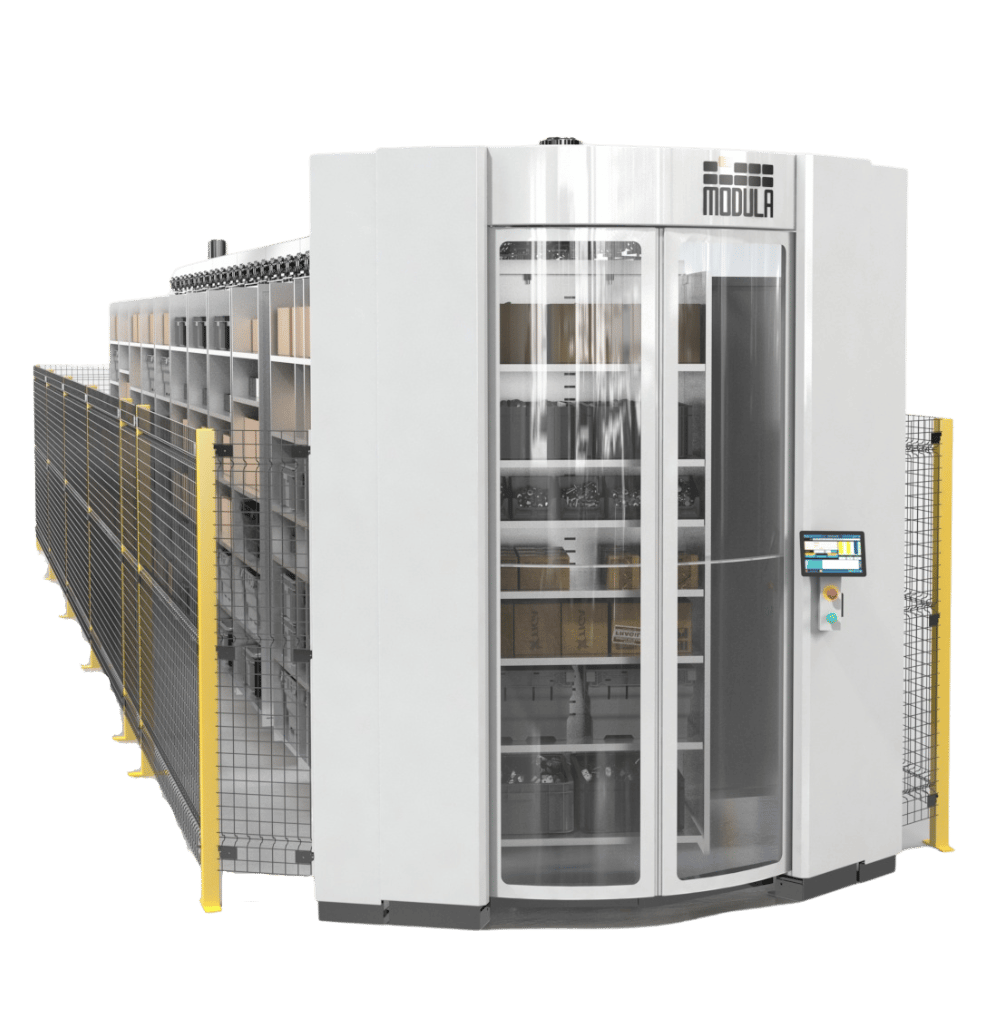
2. Modula Horizontal Carousels
Horizontal carousels are an effective storage solution for facilities with limited vertical space.
Ideal for storing boxes, packages and components, these automated systems bring items directly to operators, reducing search time and increasing productivity.
Horizontal carousels can be customized to fit specific operational needs and integrated with inventory management systems for real-time stock visibility and easier replenishment.
By combining efficient storage with fast, accurate retrieval, horizontal carousels help streamline workflows and support more productive manufacturing operations.
Check out our horizontal carousel in action in the video below!
MODULA HC: the New Horizontal Carousel for Efficient Picking
The Modula Horizontal Carousel allows you to:
- Leverage storage capacity in low-ceiling environments
- Handle large quantities of inventory
- Increase productivity by eliminating the need to travel across your warehouse
- Boost picking rates of up to 550 lines per hour
- Improve picking accuracy by up to 99% with the help of visual picking aids
- Reduce physical strain by providing an ergonomic and safe working environment
- Monitor and document all picking operations, and track stock levels in real-time to prevent stockouts
3. Modula Order Picking Solutions
Complement your storage solutions with Modula’s Order Picking Solutions to increase productivity, boost picking accuracy and eliminate mispicks.

Modula Warehouse Picking Solutions include:
- Modula Put to Light to guide your warehouse operators to the correct picking area or station. Pick multiple orders simultaneously while eliminating paper picking lists.
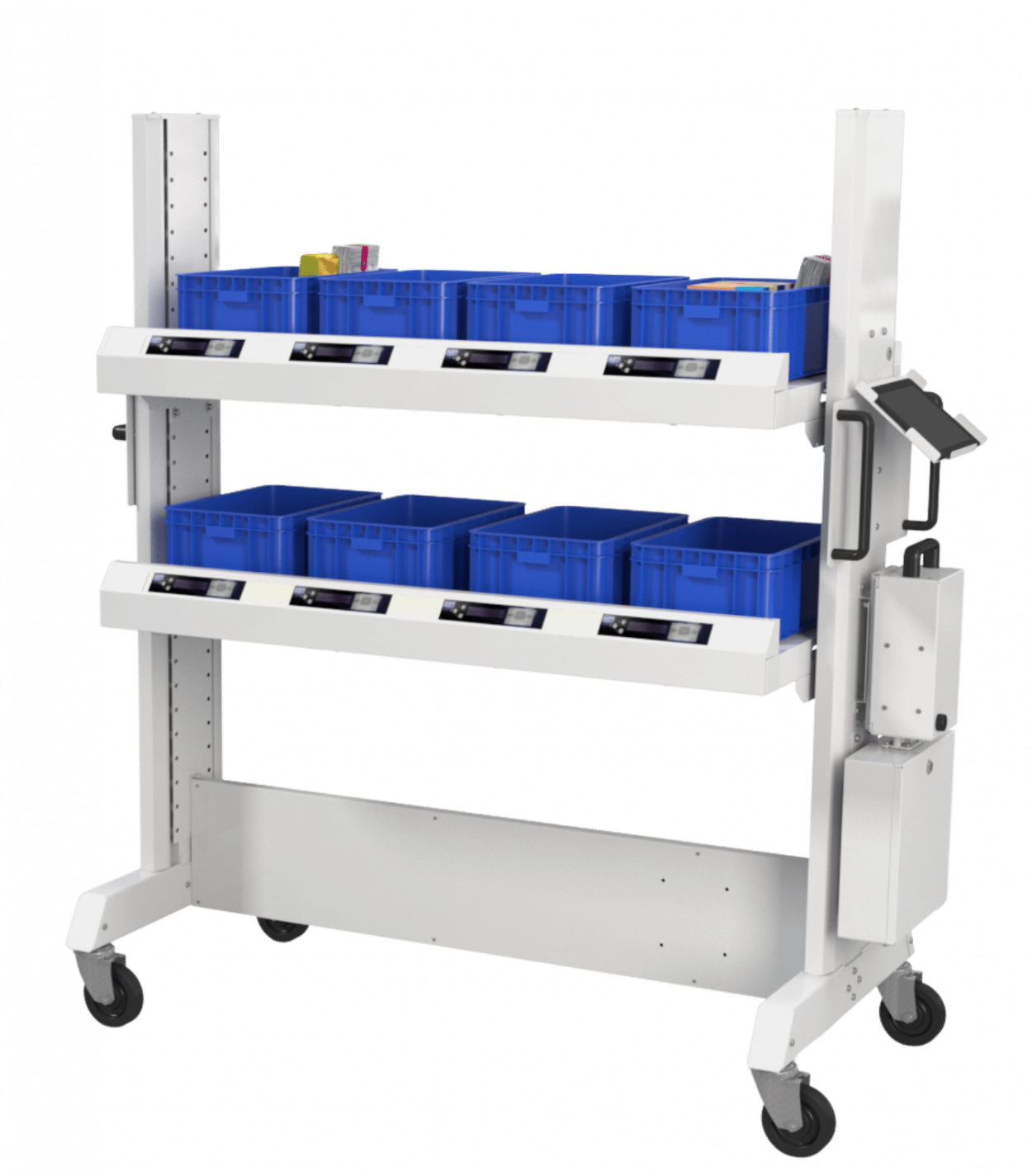
- Modula Picking Cart to transport goods to and from different areas within your warehouse. Modula Picking Cart is equipped with wheels, shelves, WiFi and Put to Light controllers, and backup batteries.
- Mobile Picking Station to process large volume orders in minimal time. The Picking Station utilizes the Put to Light system for order consolidation and batch picking.
- Modula Mobile Picking App to keep your operations under control whether on the road or at the warehouse. The Modula Mobile Picking App features a barcode scanner to scan and track items right from your smartphone or tablet.
Our order picking solutions allow you to:
- Boost picking speed by reducing the need for search items in the warehouse
- Improve picking accuracy thanks to visual picking aids such as LED bars
- Improve inventory management by getting a bird’s eye view of your current and forecasted inventory
4. Warehouse Management System
Control activities in your warehouse and get complete visibility over your inventory and more with the Modula Warehouse Management System (WMS).
Whether you manage a traditional manufacturing facility or a fully automated warehouse, you can streamline your operations with a WMS.
Just integrate your WMS with your ERP or DMS of choice to streamline your receiving, picking and putting away processes.
Choose from two Warehouse Management System solutions:
- Module WMS Base: Ideal for thriving or scalable warehouse footprints
- Modula WMS Premium: End-to-end warehouse management and inventory solutions
Our Modula WMS solutions allow you to:
- Manage your warehouse inventory with complete visibility
- Accurately and efficiently pick and replenish your inventory
- Reduce cumbersome paperwork and manual processes thanks to exceptional automation
Automation in Production: Key Takeaways
- Automation enables manufacturers to do more with existing resources by improving efficiency, reducing errors, and optimizing workflows
- Automated solutions help create safer workplaces by decreasing repetitive motions, heavy lifting, and unnecessary travel throughout the facility
- The right combination of storage, picking and inventory management technologies can help manufacturers increase productivity, maintain inventory accuracy and support long-term growth
Automation in Production: FAQs
Is manufacturing automation only for large companies?
It’s a common misconception that automation is only accessible to large manufacturers with substantial budgets.
In reality, many automation solutions can be scaled to fit smaller operations.
From automated storage systems to inventory management software, manufacturers of all sizes can improve productivity, maximize space, and decrease manual work without completely overhauling their facilities.
How does automation improve workplace safety in manufacturing?
Manufacturing environments often require employees to lift, reach, bend, and walk long distances throughout the day.
Over time, these repetitive tasks can increase the risk of injuries.
Automation helps minimize physical strain by bringing materials directly to operators and handling repetitive processes, creating a safer and more ergonomic workplace.
How can automation improve inventory management in manufacturing?
When inventory isn’t where it’s supposed to be, production delays and costly disruptions can quickly follow.
Automation helps eliminate this uncertainty by providing real-time inventory visibility and more accurate stock tracking.
As a result, manufacturers can maintain optimal inventory levels, avoid stock shortages, and keep production running without interruption.